
Birds
Available on Bookshop
Write a review
Books.org participates in affiliate programs including Bookshop.org and the Amazon Services LLC Associates Program. We may earn a commission from qualifying purchases made through links on this page, at no additional cost to you.
Log in to track your reading progress.
Editorials
Children's Literature
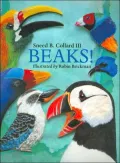
This is a scientific book, but it is also fun to read. The reader learns about the ways various species of birds use their very different beaks. Birds' beaks may be large or small, heavy or light, short or long. Each kind of beak has a different use, best adapted for eating a particular type of food. For example, the large toucan beak is deceptively lightweight for plucking berries and insects from the trees. The book also gives other uses for the beaks, like attracting mates. This book ends with a fun surprise as well as a list of interesting, bird-related Web sites. The colorful illustrations look like three-dimensional collages and really catch the reader's attention. The book is for younger elementary students, but older kids will also find it interesting and educational. 2002, Charlesbridge Publishing, Ages 6 to 12.— Paul Mauer
School Library Journal
K-Gr 4-The intricate characteristics of a variety of birds' beaks are presented skillfully through words and vividly painted, cut-and-sculpted-paper illustrations. The habits of birds and the information on how their beaks' composition allows them to eat are truly fascinating. The author explains that beaks can also help birds build nests (bowerbirds) or dig (bee-eaters). Some beaks change colors as the bird ages (seagulls) or during different seasons. The clear text is easy to follow, and students will enjoy hearing it read aloud or find it useful for reports. The lively style will facilitate rich discussion, while teaching the students the scientific facts of these feathered friends. Some of the featured species, such as song sparrows, are common, but others are quite exotic. A worthwhile resource for libraries and classrooms.-Barbara L. McMullin, Casita Center for Technology, Science & Math, Vista, CA Copyright 2002 Cahners Business Information.Kirkus Reviews
This exploration of bird beaks will fly off the shelf. Collard, a scientist, biologist, and author of over 30 nature titles, including Butterfly Count (p. 101), provides a treasure trove of interesting facts about beaks that peck, probe, crush, tear, tap, skim, scoop, stab, pry, and dig. For instance, the twisted beak of the crossbill is just perfect for prying apart the scales of pinecones to expose the seeds that it laps up with its sticky tongue. Or the large colorful toucan's beak looks heavy but is really very light because of a honeycomb construction. Some gull beaks change colors as the bird grows older, while puffins shed bright-colored beak decorations each year. The choice of artist was truly brilliant, as it is her work that sets this apart. She provides spectacular watercolor and cut-paper collages that not only complement the text, but should cause gasps of wonder. Many double-page layouts showing birds in their natural environment are suitable for display. The author provides a short quiz to "Test your beak-ability," inviting the reader to predict what birds eat by looking at their beaks. Includes a bibliography and Web sites for more information. (Nonfiction. 5-9)Book Details
Published
July 1, 2002
Publisher
Charlesbridge Publishing, Inc.
Pages
32
Format
Paperback
ISBN
9781570913884