
Genetics, Physiological Psychology, Behavioral Psychology
Available on Bookshop
Write a review
Books.org participates in affiliate programs including Bookshop.org and the Amazon Services LLC Associates Program. We may earn a commission from qualifying purchases made through links on this page, at no additional cost to you.
Log in to track your reading progress.
Overview
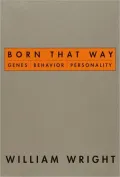
In Born That Way, William Wright takes us on a fascinating, comprehensive journey into the new world of genetic research and molecular biology to show us the work that has been done during the last half century: how the remarkable findings about gene behavior are overturning existing theories and demolishing assumptions upon which 50 years of psychological thought had been based. He writes not only about twin and adoption studies that measure and compare individuals to establish a genetic influence, but about the corroborating research in molecular biology that underlines the links between genes and personality."...reveals the findings of one researcher who studied the links between genetics and personality."
Editorials
Derek Bickerton
Born That Way is a stimulating and highly readable introduction to the nature-nurture debate....Books like these are essential for those who want to keep pace with the rapidly evolving sciences that seek to tell us exactly who we are. -- New York Times Book ReviewDiane Johnson
Wright is attempting to explain in layman's language the present state of the ancient nature-nurture debate, especially some recent discoveries about the human genome.—New York Review of Books
Publishers Weekly -
In spite of fascinating material and an engaging writing style, Wright (Sins of the Father) is largely unsuccessful in his attempt to portray the current state of the nature-vs.-nurture debate as it pertains to the underlying causes of human behavior. On the positive side, Wright does a fine job of explaining the controversy between those who believe that human behavior is significantly controlled by genetic influences and those opting for the primacy of environmental factors. Similarly, his descriptions of the results, both anecdotal and scientific, of the Minnesota Twin Study of identical twins raised apart and brought back together later in life are compelling, clearly demonstrating the importance of heredity. What detracts greatly from these successes is Wright's relentless attack on those who disagree with his pro-genes position (e.g., 'Richard Lewontin, one of the Not in Your Genes authors, who has repeatedly proved he needs no collaborators in his campaign of distortion'). Wright's calling his opponents 'gene police,' 'radical environmentalists' and 'genophobes' does nothing to elevate the level of the debate. And while Wright interviews and fully develops the personalities of many of the scientists on the 'nature' end of the continuum, he presents caricatures of those on the 'nurture' side. Nonetheless, many important public policy questions are touched on in this otherwise useful book.Booknews
Sensibly not regarding the perennial nature-nurture debate as an either/or issue, non-specialist Wright surveys the last half-century of research used to support the view that human behavior is more genetically than environmentally based. Provocative chapters address the chemistry of self, twin studies, stars of the new field, the short and happy life of the tabula rasa, the Jensen furor over race and IQ, and the possibility of a crime gene.Diane Johnson
Wright is attempting to explain in layman's language the present state of the ancient nature-nurture debate, especially some recent discoveries about the human genome. -- New York Review of BooksKirkus Reviews
An enthusiastic, informative account of the young field of behavioral genetics that could use less of the reporter and more of the subject. Wright (The Von Bulow Affair, 1983; Lillian Hellman, 1986) acknowledges himself to be a non-scientist who 'roots' for the growing view that human behavior is heavily influenced by genes, as against the traditional social science perspective that environment alone is responsible. Though this admission of journalistic bias is refreshing, Wright overdoes it: His repeated attacks on 'genophobes' begin to sound bullying. To dismiss psychoanalysis by speaking of a 'Freudian-analytic Anschluss' is not only overstated but unkind, given that Freud was a refugee from the actual Anschluss. Wright is better at expounding the thinking of behavioral geneticists, particularly their complex view of the interaction of environment and heredity, though his account of their research is lopsided. Most of the book's first third is devoted to an engrossing, detailed account of Thomas Bouchard's studies of reared-apart twins. The middle third too hurriedly covers other top researchers, such as Dean Hamer, whose recent Living with Our Genes is less contentious and better at detailing specific gene-behavior links. The last third gives a polemical account of the historical shift from eugenics to environmentalism to behavioral genetics. Wright's criticisms of intellectually dishonest 'antigene screeds' are well taken, but the constant jabbing takes up space that could have been filled with more data. In a concluding chapter on the implications of gene-behavior links, he unconvincingly theorizes that knowledge of these links can make people moretolerant. Maybe, but also more patronizing: In a discussion of abortion, Wright characterizes the pro-choice position as rational and high-minded, the pro-life position as a benighted one driven by genes. The book leaves one wishing to hear less from polemicists rooting for or against genes and more from scientists striving to find out exactly what genes do.Book Details
Published
June 6, 2012
Publisher
Knopf Doubleday Publishing Group
Pages
320
ISBN
9780307819383