
Presidental Elections & Candidates, U.S. Politics & Government - 20th Century, U.S. Politics & Government - 1992-2001, Mass Media & Politics, U.S. Politics - Campaigns & Elections
Log in to track your reading progress.
Overview
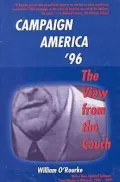
Covering the election year from his couch, William O'Rourke reproduces and dissects the characters and issues awash in the ever flowing media stream: television, radio, newspapers, magazines, Internet, phone and fax, conversation, and popular entertainment. "Every campaign gets the book it deserves," O'Rourke writes, "and the '96 presidential campaign deserves the one in your hand." Campaign America '96 reveals how the presidential campaign is consumed, not produced. Part autobiography, part chronicle, part incisive political analysis, part cultural history, Campaign America '96 parades the entire year's cast of characters across its stage. Minor and major actors take their bows, from the ineffably nontelegenic millionaire, Steve Forbes, to the ever coy Colin Powell, to sideshow contenders like Ross Perot ("Harry Truman on Ritalin"), along with the media guys and dolls who cover them, to the final showdown between Hillary and Liddy, the First Lady and the First Nurse, and Citizen Bob and Commander-in-Chief Bill.Editorials
Publishers Weekly -
This is the political diary of a couch potato who is also a novelist (Notts), professor of literature at Notre Dame and author of The Harrisburg 7 and the New Catholic Left. Day by day, beginning with December 31, 1995, O'Rourke charts what he learned about the 1996 presidential election by watching TV and listening to the radio. He paid little attention to the network evening news programs though, and concentrated on C-SPAN, Nightline, the Sunday morning talk shows, Larry King, the McLaughlin Group, Jim Lehrer's NewsHour and 60 Minutes. The radio programs he follows are those of Rush Limbaugh and Diane Rehm. And, of course, he tuned in to the debates and the televised moments from the national conventions. O'Rourke is at his best when he is like one of those folk who wants to tell you all about what he saw on TV the night before. Only he does it with wit and flair, coming up with pointed observations (e.g., the Clinton team really didn't think they were going to win in 1992 and were unprepared to govern). However much O'Rourke argues that TV presents the true face of American social culture, he's dealing with old news here; by the time the returns start coming in, the reader, entertained at first, feels trapped in a season of endless TV reruns. (Sept.)Library Journal
O'Rourke (English, Univ. of Notre Dame) has written an almost day-by-day account of media coverage of the 1996 presidential campaign and how he "consumed and processed" that coverage. He looked at the coverage provided by the major television networks, C-SPAN, newspapers and news magazines, talk radio, and other media. The diarylike format of O'Rourke's book facilitates the presentation of his personal views about the campaign and the media, but it also results in considerable repetition. In addition, although the format is an effective way of conveying the author's initial reactions, it is not conductive to reflection or analysis on the part of author or reader. On several occasions the author offers interesting observations but fails to develop them. While its focus is narrower, general and lay readers might prefer Michael Lewis's commentary on the 1996 campaign in Trail Fever (LJ 6/15/97).Thomas H. Ferrell, Univ. of Southwestern Louisiana, LafayetteKirkus Reviews
An engaging, nicely exasperated account of the 1996 campaign for the presidency, largely consisting of a day-by-day journal novelist O'Rourke (Notts, 1996, etc.) kept from January until election day. The twist here is that O'Rourke's journal is entirely about what he has seen on television, becoming as much a commentary on commentators as on the candidates and their spin doctors. The virtue of this approach is that it reminds us of the extent to which our opinions are shaped by the talking heads infesting the airwaves, and O'Rourke has some scathing offhand judgments of commentators and reporters. The downside is that it the book seems finally rather like sitting, for a very long time, with a cranky, bright, frequently witty friend, given to off-the-cuff analysis. Still, some of the set pieces here, including O'Rourke's dissection of Dole's and Clinton's convention speeches, are hilarious, and his portrait of the obsessive shallowness of the media is convincing and alarming. A highly unusual contribution to the study of politics and media.Book Details
Published
January 31, 2000
Publisher
Notre Dame, Ind. : University of Notre Dame Press, c2000.
Pages
551
Format
Paperback
ISBN
9780268022518