
Economics - General & Miscellaneous, Social Entrepreneurship & Social Responsibility of Business, Corporate Values - Case Studies, Economic Development, Sustainable Development
Log in to track your reading progress.
Overview
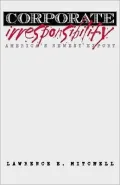
Corporations are often so focused on making short-term profits for their stockholders that they behave in ways that adversely affect their employees, the environment, consumers, American politics, and even the long-term well-being of the corporation, says Lawrence Mitchell in this provocative book. This is a significant issue not only in the United States but also in the world, for many countries are beginning to emulate the American model of corporate governance. Mitchell criticizes this emphasis on profit maximization and the corporate legal structure that encourages it, and he offers concrete proposals to bring about more socially responsible corporate behavior.Mitchell declares that managers should be freed from the legal and structural constraints that make it difficult for them to exercise ordinary moral judgment and be held accountable for their actions. He suggests, for example, that earnings reports be required annually rather than quarterly, that the capital gains tax be increased on stocks held for fewer than thirty days, and that elections of corporate boards of directors be held every five years rather than every year. Mitchell places the problem of corporate irresponsibility within the broader context of American life and demonstrates the extent to which contemporary corporate behavior represents a corruption of our cherished liberal values of personal freedom and individuality.
Editorials
Business Ethics
Brief, readable, and compelling. Recommended for those who wish to understand how corporations are governed.Choice
Topics . . . include the impact of limited liability, corporate moral judgments, wealth and social value, and investor loyalty and long-term value.Joseph William Singer
An important work about the place of corporations in economic and social life.Washington Post
[W]ell reasoned and well researched...[T]ouches all the bases-legal, financial, economic and moral-while written in an accessible, breezy style.Publishers Weekly
In the not-too-distant past, corporations served three constituencies in a fairly equal way stockholders, employees and customers. That paradigm, Mitchell argues quite persuasively, has given way to one overriding goal: profit maximization and the creation of greater shareholder wealth. According to Mitchell, the laserlike focus on short-term profits instead of long-term sustainable growth causes corporate managers to abandon concerns for employees, customers, the environment and society at large to ensure that their company meets its quarterly profit targets, which will keep stock prices rising. Mitchell, a law professor at George Washington University, further argues that managers are forced to place profit maximization above all else, not out of personal greed, but because of the legal structure of modern corporations. To once again make corporations more accountable, Mitchell offers a number of suggestions, including extending corporate directors' terms, requiring companies to disclose figures on a yearly rather than quarterly basis and, in his most original proposal, changing accounting methods to treat employees as assets rather than liabilities. This is an important, provocative book that is sure to stir debate between groups who advocate the need for more corporate accountability and those who see nothing wrong with the status quo. (Jan.) Copyright 2001 Cahners Business Information.Book Details
Published
January 1, 2002
Publisher
Yale University Press
ISBN
9780300137767