
Fiction - Island Peoples, Places & Cultures, Fiction - General & Miscellaneous, Fiction - Emotions & Behaviors, Fiction - Family Life, Fiction - U. S. People, Places & Cultures
Log in to track your reading progress.
Overview
In Cousins a little girl lives in two opposite worlds. There’s the house where she lives with her father and grandmother that is full of beautiful and expensive things, but rather quiet. Then there’s her other grandmother’s house where her cousin lives, which is always brimming with people. She loves her cousin’s world. But when she does something she regrets, she must confront her feelings of guilt. Eventually, she realizes she is very lucky to be able to move gracefully between two such wonderful worlds.
Editorials
Children's Literature
This cross-cultural tale is told from the point of view of a young Latino girl who lives with her grandmother Mimi. Showered with beautiful clothes, books, and love, the narrator still finds much to envy when she visits her Abuela Adela, where her cousin Miranda lives with her mother and lots of aunts, uncles, and little baby cousins. Miranda is looking forward to her first communion when she will be allowed to carry the precious moonstone rosary that is displayed next to the life-sized statue of el nino Jesus in Abuela Adela's house. There are important lessons to be learned about jealousy, honesty, and forgiveness in this book. The Spanish words sprinkled throughout the text are unobtrusive and listed in a glossary at the end of the story. Brightly colored naive paintings add to the authenticity of the tale. 2004, Groundwood Books, Ages 5 to 9.—Carole J. McCollough
School Library Journal
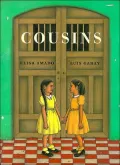
Gr 1-4-A little girl is the focus of this exploration of the tensions inherent in belonging to two cultures. The child lives with her Latin American father and North American maternal grandmother. With Mimi, she has everything she could possibly want, except a sense of community. She often visits her Abuela Adela for refaccion (snack) after school. This busy Hispanic household is full of extended family, including her cousin, Mariana, who is about to make her first communion. The narrator, who is not Catholic, is so intensely envious that Mariana will get to carry the moonstone rosary that is kept with a statue of the Ni-o Jes s that she steals it. Although overcome with fear and guilt, she is unable to confess. When Mimi finds the rosary in the child's bathrobe pocket, her granddaughter runs to the church. The priest walks her home and stands by as she confesses, apologizes, and is forgiven. There is no clear resolution-only a delineation of the child's feelings and her sense of being torn between two ways of living. Although this story is slightly disquieting, it is an excellent discussion starter and segue into longer books on acculturation, such as Gary Soto's The Skirt (Dell, 1995) or Alma Flor Ada's My Name Is Maria Isabel (Atheneum, 1993). Garay's acrylic paintings in a primitive style with crisp black outlines and a warm yet muted palette are arresting and distinctly reminiscent of Diego Rivera's or Jos Clemente Orozco's work. An intriguing read.-Ann Welton, Grant Elementary School, Tacoma, WA Copyright 2004 Reed Business Information.Kirkus Reviews
Sin, Confession, and Forgiveness are the dominant themes in this spare tale of a bi-cultural child shuttled between worlds. Though she lives with her widower father and nonreligious grandmother Mimi, after school each day the narrator goes to the extended household of her Abuela Adela for a refacci-n (snack)-where, fascinated by a statue of Ni-o Jesus and jealous of cousin Mariana, who is about to make her First Communion, she one day impulsively pockets Abuela's beautiful rosary. Garay sets the episode in no identifiable country, but the furnishings, decorations, colors, and brown-skinned people in both houses add up to a distinctly southwestern or Hispanic look. A restless night later, the child steals away to a church, where a young priest hears her tale and takes her back to her Abuela's for a remorseful confession, mild chiding, then hugs and kisses. The tone is earnest, but there is no preaching-and not only will young readers or listeners understand this child's motives, her religious and family issues are sure to spark reflection and discussion. (Picture book. 6-8)Book Details
Published
March 1, 2004
Publisher
Groundwood Books
Pages
32
Format
Hardcover
ISBN
9780888994592