
Clinical Medicine, Landscape & Environment - Social Aspects
Available on Bookshop
Write a review
Books.org participates in affiliate programs including Bookshop.org and the Amazon Services LLC Associates Program. We may earn a commission from qualifying purchases made through links on this page, at no additional cost to you.
Log in to track your reading progress.
Overview
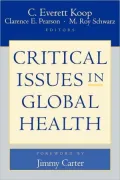
Critical Issues in Global Health is an outstanding compAndium of knowledge and thought--from a distinguished panel of internationally renowned medical and public health experts--that offers insight into the most important health issues facing our world's populations. The volume's individual contributors represent a wide range of prestigious health organizations and institutions including the World Health Organization, National Academy of Sciences, Kellogg and Rockefeller Foundations, U.S. Centers for Disease Control, and the American Public Health Association. Edited by C. Everett Koop, Clarence E. Pearson, and M. Roy Schwarz, these never-before-published essays explore the future of international health and explain what will be required in order to provide adequate health and medical care worldwide, especially for underdeveloped countries.Editorials
From the Publisher
"The book would make an excellent reference..." (Annals of Pharmacotherapy, April 2003)"...is an excellent overview for those with an interest in improving global health." (New England Journal of Medicine, August 28, 2003)
Medical and public health specialists from around the world survey the state of health in various countries, continents, and the world as a whole; the organizational landscape in global health; and organizations, management, leadership, and partnerships. The anthology is a call to action for citizens and public policy makers, not a scientific treatise. Annotation c. Book News, Inc., Portland, OR
From The Critics
Reviewer: Linda C. Baumann, PhD, RN, CS, FAAN(University of Wisconsin-Madison)Description: This compendium of essays, written by international health experts who represent an array of organizations and schools of public health, offers insights into topics selected as the most important issues facing the world's population.
Purpose: Chapters explore the present and future of global health and highlight the needs of developing countries. Some are excellent reviews and others seem to superficially cover complex topics.
Audience: This is an excellent overview for a graduate course on international health. The editors offer insights from experts on future needs in areas of research, health promotion, disease prevention, and financing healthcare.
Features: This book is divided into three parts. Part one reviews the population health status of eleven countries. Part two contains 29 chapters on topics relevant to global health—from chronic disease and tobacco control to terrorism and the relationship between oceans and human health. Chapters are written by recognized and accomplished experts from organizations such as the World Health Organization, Kellogg Foundation, Rockefeller Foundation, and the American Public Health Association. The major weakness of the book is the inconsistency between chapters in the depth and scope of the topic covered.
Assessment: I am unaware of similar books in the field. I find some chapters disappointing — too general and too brief an overview of a complex topic to be of much value. I liked the organization of the book, with Part one containing a geographic perspective on global health status, Part two setting the specific agenda of topics for the future, and Part three containing descriptions of successful demonstrations of new approaches and new organizational and leadership models that will be needed. The book was generally convincing in its attempt to define the critical global health issues of the future.
Book Details
Published
September 10, 2002
Publisher
San Francisco : Jossey-Bass, c2002.
Pages
504
Format
Paperback
ISBN
9780787963774