
Linguistics & Semiotics, Language Families, Anthropology
Log in to track your reading progress.
Overview
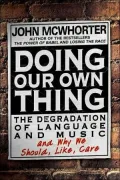
There was a time in America when presidents such as Lincoln, Roosevelt, and Kennedy exhorted our country to greatness with orations replete with elevated diction and measured rhetorical technique. But today the hearts and minds of our weary nation are implored by a president whose idea of eloquent phrasing is "Let's roll." How did this transformation in our civic and personal communication take place? And what hope can we harbor for a better-spoken society in the future? In Doing Our Own Thing, critically acclaimed linguist and cultural critic John McWhorter traces the precipitous decline of language in contemporary America, arguing persuasively that casual, everyday speech has conquered the formal in all arenas, from oratory to poetry to everyday journalism (and has even had dire consequences for our musical culture). McWhorter argues that the swift and startling change in written and oral communication emanated from the countercultural revolution of the 1960s and its ideology that established forms and formality were autocratic and artificial. While acknowledging that the evolution of language is, in and of itself, inevitable and often benign, McWhorter warns that the near-total loss of formal expression in America is unprecedented in modern history and has reached a crisis point in our culture in which our very ability to convey ideas and arguments effectively is gravely threatened. By turns compelling and harrowing, passionate and judicious, Doing Our Own Thing is required reading for all concerned about the state of our language -- and the future of intellectual life in America.Editorials
From Barnes & Noble
In books such as The Power of Babel and Losing the Race, linguist John McWhorter demonstrated that culture endures despite shifts in language. But such changes can have dire consequences. In Doing Our Own Thing, he argues that the triumph of casual over formal speech is degrading our vocabularies, blurring our syntactic road maps, and, ultimately, endangering our intellectual and artistic capacities. Using examples from contemporary political figures, McWhorter shows how the decay of civic communication has polluted public debate.The New York Times
… McWhorter charts certain dire cultural consequences of a mounting distrust of written English. With its repertory of constructions and its bonanza of vocabulary, formal English is the natural idiom for conveying nuance, respect and logical argument. When it goes, they go. McWhorter notes that when Woodrow Wilson sought to bring America into the League of Nations in 1919, he felt duty-bound to answer all objections in carefully framed oratory. But when George W. Bush tried to sell the Iraq war, he retreated from public view once he had made his case in a few broad, bromidic strokes. ''Why not an extended speech,'' McWhorter asks, ''that really got down to cases, addressing sequentially and in pointed fashion the objections of The Nation, Mother Jones, the New York Times editorial page and Dominique de Villepin,'' the French foreign minister? The reason the president made no such speech, McWhorter thinks, is because he could not; putting forth arguments of any kind is ''simply not part of American culture'' anymore. — Christopher CaldwellPublishers Weekly
Linguist and show-tune aficionado McWhorter (Losing the Race) explores why American language and music are no longer crafted, honored or even well-regarded means of expression. The expected social formality of an earlier era, he argues, was eroded by the individualistic, multicultural values of the 1960s. The result: we talk rather than lecture, and we choose 50 Cent over Mahler. By unearthing Victorian-era speeches, early 20th-century newspapers and presidential addresses from the family Bush, McWhorter shows just how American English has, over time, taken on a permanent casual Friday uniform. McWhorter, who is African-American, suggests that hip-hop, spoken-word poetry and black English are the current defining modes of expression, with their fight-the-power messages of distrusting authority and "keeping it real." But, he notes, in contrast to the gentle, erudite oratories of the past, "[p]oetry that shouts can only be a sideshow. It cannot inspire a nation." Laden with contemporary pop culture references and humorous asides, this is an entertaining polemic that brings linguistics to the people, while lamenting the populist mentality that has made being cool more critical than being articulate. (Oct.) Copyright 2003 Reed Business Information.Library Journal
Berkeley linguist McWhorter (Losing the Race: Self-Sabotage in Black America) argues that language has been so debased since the triumph of the Sixties that our ability to read, write, and even think has been severely compromised. Copyright 2003 Reed Business Information.Book Details
Published
November 1, 2003
Publisher
New York : Gotham Books, c2003.
Pages
304
Format
Hardcover
ISBN
9781592400164