
Teen Fiction - Body, Mind & Health, Teen Fiction - Girls & Young Women, Teen Fiction - Entertainment & Arts, Teen Fiction - Family & Relationships, Fiction - Family Life
Available on Bookshop
Write a review
Books.org participates in affiliate programs including Bookshop.org and the Amazon Services LLC Associates Program. We may earn a commission from qualifying purchases made through links on this page, at no additional cost to you.
Log in to track your reading progress.
Overview
Fourteen-year-old Harley Columba is convinced she's adopted. She's nothing like her abusive, alcoholic father or her bitter, romance novel-reading mother. They have brown eyes, but Harley's eyes are blue. They argue and drink and thrive in dreary suburbia while Harley paints, writes poetry, and longs for a different family and a better life. But then she finds a new, startling piece of evidence: a harlequin doll that's been hidden away for years, with a note around its neck: "Papa loves you forever and a day." Now Harley has genuine hope--hope that she can escape the chaos of the Columba household. Hope that she can find her real father.Tough, funny, and refreshingly honest, Harley, Like a Person is a compelling story of family, the power of creativity, and the enduring strength of self.
From the Trade Paperback edition.
Fourteen-year-old Harley, an artistic teenager living with her alcoholic father and angry mother, suspects that she is adopted and begins a search for her biological parents.
Editorials
KLIATT
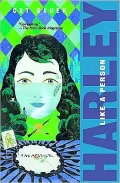
Bauer wrote this to complete the short story "Run Away" in Sassy magazine, after so many letters came from readers asking what happened to the main character. First, let me say that the cover is intriguing but hard to describe: suffice it to say, it will attract YA readers—accentuating Harley's eyes, her blue eyes, which tip her off that she may not be the biological child of her brown-eyed parents. Harley is a freshman in high school, from a home where there is explosive anger and a great deal of fear and loathing. She has been a "good girl" making straight A's and trying to obey her demanding parents. This novel chronicles her slide downhill: failing in school, fighting with her best friend, falling in love with an older drug dealer, lying, screaming, drinking, and finally running away from home. Much of this drama is like a soap opera, filled with hysteria and other scenes of passion. (This may not appeal to adult readers, but it will be fascinating to YAs, especially since Harley is such an attractive, essentially likable protagonist.) Much of her downfall centers on her obsession that her parents have been lying to her; she wants to know the truth about her birth and whether she was adopted. Her persistence does pay off and finally she uncovers these secrets and confronts her biological father. With the truth, at the end, comes the promise of healing and redemption. The depths of Harley's destructive behavior are the scenes in which she is hanging out with her new boyfriend, the one who gets arrested finally for dealing drugs. She drinks, smokes pot, experiments with sex (not described in detail), lies to her parents, and generally is just lucky that the repercussionsof these irresponsible behaviors aren't worse. What saves Harley is her intelligence, her imagination and creative abilities, which Bauer describes best. Harley is a gifted artist, who escapes into images when things get really bad. Because of the marvelously authentic-sounding first-person narrative, readers will love Harley and admire her gritty search for answers, worry over her wild behavior, and be happy at the resolution of this story. KLIATT Codes: JS—Recommended for junior and senior high school students. 2000, Winslow, 248p, 99-046814, $16.95. Ages 13 to 18. Reviewer: Claire Rosser; July 2000 (Vol. 34 No. 4)VOYA
In a neverfaltering voice, fourteenyearold Harley Columba relates the events of her freshman year, including family secrets and the realities of being an artistic girl in a dysfunctional suburban family. Her father drinks and gets abusive, and her mother yells. Harley and her younger brother and sister endure in silence. Unanswered questions lead Harley to believe that she is adopted. Harley's changing reactions lead to a loss of old friends, new boyfriends, lies and deceptions, and grass and alcohol. The results are failing grades and constant grounding. Her artistic ability is recognized, however, and she is given an opportunity to paint sets for the school play. From teachers and friends, she learns things about her parents and discovers evidence that supports her adoption theory. Through growing defiance of her parents and anger at school, she is removed from her cherished art project. Finally compelled to leave her home in the suburbs, Harley goes to the city to meet the man she believes is her father. What begins with rejection results in confirmationbut with some twists. Understanding the truth and confronting her parents allows them all to begin to find some reconciliation and a new perspective on their family life. This novel is a solid and enticing read for teens. Although the outcomes are not uneXpected, they do not necessarily follow any formulas. Harley's voice is true to the eXperience of many young people. Note that the book was released simultaneously in paperback with a very catchy cover. VOYA CODES: 4Q 4P J S (Better than most, marred only by occasional lapses; Broad general YA appeal; Junior High, defined as grades 7 to 9; Senior High, defined as grades 10 to 12).2000, Winslow, 248p, $16.95, $6.95 Trade pb. Ages 13 to 18. Reviewer: Patricia MorrowSOURCE: VOYA, October 2000 (Vol. 23, No. 4) <%ISBN%> 1890817481
School Library Journal
Gr 7-10-At 14, Harley is possessed by the idea that her verbally abusive father can't possibly be her natural parent. Growing up in a working-class New Jersey neighborhood, she has known the same people all her life, but only recently has she discovered a harlequin doll, addressed to her on her second birthday, with a note from "Papa." The handwriting isn't her dad's and that gives Harley enough reason to look for factual evidence to support her feeling of having been adopted. Told in Harley's voice, the story veers between self-centered capriciousness and bravery. The details are realistic, and Harley's search for her birth father is flawed but credible in method. Minor characters have disappointingly flat walk-on roles. Harley's siblings are barely more than names; the grandmother on whom she dotes dies offstage within pages of being introduced; the disciplinarian at Harley's school does a mean Jekyll-and-Hyde imitation without explanation; even Harley's birth father is dismissed almost as soon as she discovers his identity. This isn't a novel with literary flair but it is a well-felt story with real appeal to Harley's peers. The facts of her life, and her emotional health, are complex. Young teens seeking stories about troubled homes and strong girls who persevere in the face of unimpressive adults will not be disappointed.-Francisca Goldsmith, Berkeley Public Library, CA Copyright 2000 Cahners Business Information.|Kirkus Reviews
paper: 1-890817-49-X Living in a thoroughly dysfunctional family, with an alcoholic father and an enabling mother, Harley Columba feels and hopes that she is adopted. Researching her birth certificate, she finds discrepancies that start her on a path to finding her birth father. An old yearbook, a toy clown, and a handwritten note in the attic point to a high school beau of her mother's, Sean Shanahan. Harley's search for some sort of relief from her abusive father and her helpless mother lead her through some experimenting with the wild kids in school, getting her deeper in trouble at home. Finally, she lights out for New York City, confronts Sean, and hears the unvarnished truth. Still as irresponsible as ever, Sean admits that he has sired two children out of wedlock: Harley and her best friend, Carla. The sub-plot, which hints at Harley's artistic abilities, is nearly drowned out by the senseless comments and violence of her abusive stepfather, which caused her to seek refuge, starting from the first page. But it is clear that her art comes from the father who left her behind. Returning home, Harley and her parents make a small step toward peace. But this ending seems tacked on and the stepfather's shift in attitude hard to believe. It is only the author's facility with words that saves this from becoming soap opera of the first order and it might have succeeded better had the narration not been in the first person. An okay first novel, with a promise of better to come. (Fiction. YA)Book Details
Published
February 25, 2009
Publisher
Random House Children's Books
Pages
288
Format
Hardcover
ISBN
9780307485823