
British Art, Romanticism in Art, Painters - Biography
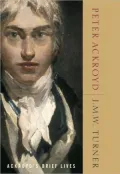
Available on Bookshop
Write a review
Books.org participates in affiliate programs including Bookshop.org and the Amazon Services LLC Associates Program. We may earn a commission from qualifying purchases made through links on this page, at no additional cost to you.
Log in to track your reading progress.
Overview
In this second volume in the Ackroyd’s Brief Lives series, bestselling author Peter Ackroyd brings us a man of humble beginnings, crude manners, and prodigious talents, the nineteenth-century painter J. M. W. Turner.Joseph Mallord William Turner was born in London in 1775. His father was a barber, and his mother came from a family of London butchers. “His speech was recognizably that of a Cockney, and his language was the language of the streets.” As his finest paintings show, his language was also the language of light. Turner’s landscapes—extraordinary studies in light, colour, and texture—caused an uproar during his lifetime and earned him a place as one of the greatest artists in history.
Displaying his artistic abilities as a young child, Turner entered the Royal Academy of Arts when he was just fourteen years old. A year later his paintings appeared in an important public exhibition, and he rapidly achieved prominence, becoming a Royal Academician in 1802 and Professor of Perspective at the Academy from 1807–1837. His private life, however, was less orderly. Never married, he spent much time living in taverns, where he was well known for his truculence and his stinginess with money.
Peter Ackroyd deftly follows Turner’s first loves of architecture, engraving, and watercolours, and the country houses, cathedrals, and landscapes of England. While his passion for Italy led him to oil painting, Turner’s love for London remained central to his heart and soul, and it was within sight of his beloved Thames that he died in 1851. His dying words were: “The sun is God.”
Also available inACKROYD’S BRIEF LIVES
Chaucer
Editorials
Publishers Weekly
In the second volume of his Brief Lives series, which commenced with a biography of Chaucer, Ackroyd presents another major cultural figure, the English painter Joseph Mallord William Turner (1775-1851). In straightforward fashion, Ackroyd outlines the career of this remarkable man, who progressed rapidly from his early years as a student at the Royal Academy to prominence as one of England's foremost painters, creating dramatic works in which he explored the glowing effects of light fused with air, water, fire and steam. Turner's paintings, which often approach abstraction, astounded and shocked his critics, causing some to say he was a madman, an assessment reinforced by his eccentric, irascible character. Ackroyd shows how the artist, who never married and lived all his life with his father -though he had secret liaisons and two illegitimate daughters-was obsessed with his art, but was also an astute businessman, opening his own gallery in London when he was only 29, cultivating prosperous patrons and speculating in land and houses, all the while turning out a multitude of dazzling oil paintings, watercolors and engravings. This is a short but intriguing introduction to the life and output of an artist who claimed that he knew of "no genius but the genius of hard work." Illus. not seen by PW. (Jan.) Copyright 2005 Reed Business Information.Kirkus Reviews
An acutely limned miniature of J.M.W. Turner (1775-51), whose watercolors, engravings and spectacular oils mark him as England's greatest painter of air, earth and water. Whether the culmination of the Romantic period or the harbinger of Cezanne and van Gogh and all we've come to call modern, Turner invented a new pictorial language that baffled contemporaries-except, perhaps, for the preternaturally incisive John Ruskin. Ackroyd (Chaucer, 2005, etc.) comments smartly on the art but focuses on the man, a genius peculiar to London, comparable to Blake, Hogarth and Dickens. Descended from a line of barbers and butchers (his mother was committed to an insane asylum) and raised amid the clamor of Covent Garden, Turner escaped anonymity through his father's encouragement, his talent and his unremitting hard work. Elected to the Royal Academy at an astonishingly young age, he conducted most of his career as England's best known and best paid painter. An awkward poet, a halting public speaker, an avid angler and sailor, Turner was highly secretive and protective of his work. He traveled widely throughout Britain and the continent, admiring particularly the charms of Venice and the canvasses of Rembrandt, Canaletto and, above all, Claude Lorrain. Taciturn and brusque, he single-mindedly pursued his art and reserved any affability for small children and a few close patrons. On the condition his paintings be kept together, he willed a large portion of his work to the nation, and today the shipwrecks, fires, storms and atmospheric chaos Turner so brilliantly captured constitute the chief ornament of London's Tate Gallery. A short biography, but one no less satisfying for the wide-ranging eruditionAckroyd brings to the task.Book Details
Published
December 18, 2007
Publisher
Knopf Doubleday Publishing Group
Pages
192
ISBN
9780307423658