
United States Studies - General & Miscellaneous, U.S. Politics & Government - 19th Century, Confederate States of America - Biography, Nationalism & Sovereignty - History, National Characteristics - North America, Southern Region - History - General & Mis
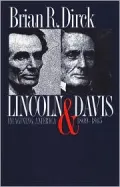
Available on Bookshop
Write a review
Books.org participates in affiliate programs including Bookshop.org and the Amazon Services LLC Associates Program. We may earn a commission from qualifying purchases made through links on this page, at no additional cost to you.
Log in to track your reading progress.
Overview
"This is intellectual history at its most stimulating."—William C. Davis, author of Jefferson Davis: The Man and His Hour"Provides fascinating new insights into the personalities and policies of Lincoln and Davis. In the process, it explores the crucial issue of national identity that served as the fulcrum of nineteenth-century politics—and social psychology. Innovative, insightful, and well-written, it offers a fresh perspective on some of the oldest issues in American history."—David Shi, author of America: A Narrative History
"A psychologically sophisticated, novel analysis not only of the two Civil War presidents but also of American nationalism broadly conceived."—Michael Burlingame, author of The Inner World of Abraham Lincoln
Author Biography: Brian R. Dirck is assistant professor of history at Anderson University.
Editorials
Publishers Weekly
Any schoolchild knows that Lincoln was the great American hero who freed the slaves, and Jefferson Davis was a traitor who defended slavery. But this easy dichotomy, argues Dirck, while not completely wrong, misses far more interesting personal and historical comparisons between the two. Dirck, an assistant professor of history at Anderson University, has focused here on appraising and evaluating these leaders' individual notions of nationalism. Lincoln and Davis conceptualized the underlying nature of the U.S. (what Dirck calls "imagined communities") in radically antithetical terms: the former's "nation of strangers" unable to know one another's heart as distinctly opposed to Davis's "community of strangers" in which "national bonding [was] a matter of sentiment" and honor. Dirck's investigation yields fascinating results. "Nationalism," he says, "is not an idea, it is an emotion, something more akin to religion than a political party." He draws upon a wide range of his protagonists' personal experiences relationships with fathers, friendships, home lives to sketch emotional, psychological and political profiles. Because his conceptual terms are so broad, it often feels as though Dirck is skimming important material a mere two paragraphs on presidents' near-dueling experiences feels foreshortened in a discussion of Lincoln's concept of "honor" but he offers enough interpretation and unique material (Mary Todd Lincoln and Varina Davis used the same African-American dressmaker) to overcome what might have been a tendency toward oversimplification. While not quite proving that his analysis "turns traditional perspectives on Davis and Lincoln upside down," Dirck does present a provocativeand potentially fruitful new interpretation of U.S. culture and intellectual history. (Nov.) Copyright 2001 Cahners Business Information.Library Journal
Dirck's book provides a splendid comparative analysis of how the main protagonists' upbringing and everyday lives shaped the characters of Lincoln and Davis and colored their respective perceptions of America as a national community. Dirck (history, Anderson Univ.) shows that Lincoln's frontier individualism influenced his notion of a "nation of strangers" held together by the rule of law, while Davis's restricted Southern upbringing and martial conditioning at West Point molded his idea of a "community of sentiment" based on codes of honor. As Americans took sides after Fort Sumter, according to Dirck, President Davis's imagination required a nation (the Confederacy) of like-minded men and women who, in turn, carried out the will of a like-minded God. As commanders in chief, Davis understood military protocol; Lincoln did not. Davis spoke of soldiers' honor; Lincoln spoke of their suffering. Davis believed the war created a national character; Lincoln believed that character was necessary to resist the difficulties and temptations caused by the war. This thoughtfully organized, engagingly written, and well-researched book is recommended for all Lincoln, Southern, and Civil War collections. John Carver Edwards, Univ. of Georgia Libs., Athens Copyright 2001 Cahners Business Information.Book Details
Published
November 30, 2001
Publisher
Lawrence : University Press of Kansas, c2001.
Pages
326
Format
Hardcover
ISBN
9780700611379