
U.S. Authors - 20th Century - Literary Biography, Editors, Publishers, Agents, & Booksellers - Literary Biography, Journalists - News & Media Biography, Critics & Historians - Literary Biography, General & Miscellaneous Literary Biography
Available on Bookshop
Write a review
Books.org participates in affiliate programs including Bookshop.org and the Amazon Services LLC Associates Program. We may earn a commission from qualifying purchases made through links on this page, at no additional cost to you.
Log in to track your reading progress.
Overview
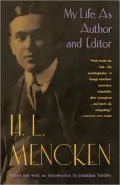
After thirty-five years in a sealed vault, the autobiography of America's great social and literary critic now comes to light, edited and with an introduction by Jonathan Yardley. H. L. Mencken stipulated in his will that the manuscript not be read for thirty-five years so that no one mentioned in its pages would still be alive on publication, thus giving the author the freedom to write what he pleased. The narrative contains many profiles and reminiscences covering Mencken's years in the magazine world, particularly with the Smart Set, which he co-edited with George Jean Nathan. The heart of the book, however, lies in the descriptions of the relationships - rivalries, feuds, friendships and mentorships - that Mencken carried on with many of the significant writers of the twentieth century, including Theodore Dreiser, James Joyce, Willa Cather, Ezra Pound, Eugene O'Neill, Frank Harris, F. Scott Fitzgerald, Aldous Huxley and Sinclair Lewis. Full of wonderfully revealing anecdotes and biting observations, these pages are spiked with his trademark outrageous and pugnacious wit, as well as his alarming frankness. Although the memoir breaks off in the early 1920's because of a stroke he suffered in 1948, it contributes significantly to our understanding of the legendary literary era of which he was at the center. It also makes abundantly clear - if proof were ever needed - why he was our greatest social commentator, and why he has had an enduring impact on American society and letters.In this candid memoir, sealed in a vault for 35 years after Mencken's death, the literary figure recounts his career as a critic, essayist, and editor of the ground-breaking magazine Smart Set and observes the literary crowd of his day Sinclair Lewis, Fitzgerland, Dreiser as well as his own Prohibition-day soirées.
Editorials
Chicago Sun-Times
"Well worth the wait . . . irreverent, inimitable, often outrageous . . . and, above all, compelling."--Chicago Sun-Times.Publishers Weekly -
Mencken's unfinished, leisurely memoir, which he set aside in 1948 following a severe stroke and ordered locked away for 35 years after his death, covers his literary apprenticeship, his co-editorship of The Smart Set and his feuds and friendships with Theodore Dreiser, Sinclair Lewis, F. Scott Fitzgerald, Ezra Pound, Alfred Knopf and others. There is much of the bellicose Mencken here, lamenting ``the always dipping curve of American imbecility,'' deflating the Algonquin Roundtable literati and offering ruthlessly candid literary portraits. Yet, along with the dour sage of Baltimore, we get Mencken the vivacious gadabout, tippler and admirer of women as his intellectual equals. Mencken annoys with his frequent anti-Semitic remarks, his pro-German stance in WW I and other prejudices. Washington Post book critic Yardley, who has trimmed the original manuscript by 60%, provides an informative introduction to this period piece, which focuses on the years 1908-1923, with forays into the '30s and '40s. Jan.Kirkus Reviews
The unmistakable iconoclasm of Mencken resounds again in this memoir of his early days in the literary trade. The original 1,000- page manuscript, sealed in a vault for 35 years after Mencken's death, has been trimmed 60 percent by Pulitzer-winning book-critic Yardley (Our Kind of People, 1989, etc.). Many of the deleted passages evidently dwelled on the trivial—and even in the finished product only an accountant could love Mencken's itemizations of his financial affairs. Admirers might wish that Yardley had also used the blue pencil on the casually flagrant stereotypes that litter this memoir much as they did The Diary of H.L. Mencken (1989), particularly those brief but pungent comments like the one about publisher Philip Goodman, who remained Mencken's friend "until the shattering impact of Hitler made him turn Jewish on me." The autobiography lacks some of the raffish nostalgia of Mencken's Days trilogy, an absence reflecting bitterness over America's second war with his beloved Germany, but it still offers an invaluable record of Mencken's impact on American letters until the early 1920's (a 1948 stroke prevented him from chronicling his stewardship of the American Mercury and his later journalism). Mencken is justifiably proud of how he and George Jean Nathan turned the cash-starved Smart Set into a forum for America's brightest newcomers. He cheerfully recalls the feuds and quirks (often alcohol-induced) of now-obscure neophytes, as well as of the more famous, including Scott Fitzgerald, Sinclair Lewis, Willa Cather, Ezra Pound, and Aldous Huxley. Mencken's description of his stormy friendship with Theodore Dreiser is masterful, as admiring of the latter's clumsy genius asit is exasperated with his oafishness ("Whenever an obvious fact competed for his attention with a sonorous piece of nonsense, he went for the nonsense"). Often comically brilliant in detailing Mencken's "sharp and more or less truculent dissent from the mores of my country"—and always brutally frank about others' foibles and his own prejudices.Book Details
Published
January 1, 1995
Publisher
New York : Vintage Books, 1995, c1992.
Pages
484
Format
Paperback
ISBN
9780679741022