
Electromagnetism - Radiation, Earth Science - General & Miscellaneous, Nuclear Engineering
Log in to track your reading progress.
Overview
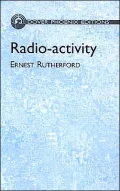
This account of the properties of naturally radioactive bodies was written from a physical standpoint by the Nobel Laureate known as the father of nuclear physics. In this classic 1904 work, Ernest Rutherford describes his pioneering studies of subatomic physics: the brilliantly conceived experiments that resolved the mysteries of radioactivity, revealing that some heavy atoms spontaneously decay into slightly lighter atoms. Radio-activity is the book that first brought Rutherford to world attention, and in it, he devised much of the terminology employed ever since in defining the theoretical concepts of the atom and the phenomenon of radioactivity. Starting with a discussion of radioactive substances, Rutherford proceeds to examinations of the ionization theory of gases, methods of measurement, the nature of radiation, and the rate of emission of energy. Subsequent topics include the properties of radiation, the continuous production of radioactive matter, radioactive emanations, excited radioactivity and radioactive processes, and radioactivity of the atmosphere and of ordinary materials.Synopsis
A classic 1904 work, Nobel Laureate Ernest Rutherford describes his pioneering experiments with radioactivity. Includes a discussion of radioactive substances, examinations of the ionization theory of gases, methods of measurement, the nature of radiation, and the rate of emission of energy. Also includes properties of radiation, the continuous production of radioactive matter, radioactive emanations, more.
Book Details
Published
June 1, 2004
Publisher
Dover Publications
Pages
416
Format
Hardcover
ISBN
9780486495859