
Spelling, English Dictionaries & Thesauri, Vocabulary, English Grammar
Log in to track your reading progress.
Overview
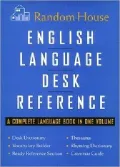
Having spelling problems? Not sure whether to spell it demur or demure? faint or feint? lagard or laggard? For quick answers, check the Desk Dictionary. Or if you know the pronunciation but not the spelling, consult the Table of Sound-Spelling Correspondences. Eager to build up your vocabulary? Study the easy lessons and do the exercises in the Vocabulary Builder. Having questions about grammar or usage? Dip into the chapter on Grammar, Usage, and Punctuation. And if you need a good synonym or antonym, try the handy Thesaurus, containing more than 80,000 synonyms and antonyms. But there's more. The Random House English Language Desk Reference includes such practical sections as the Concise Guide for Writers, Avoiding Sexist Language, and the Ready Reference Guide. In addition to the 30,000-word Desk Dictionary of American English, there is also an illuminating Rhyming Dictionary for versifiers, lyricists, and the poet in all of us.This all-in-one handbook incorporates sections on vocabulary building, grammar, spelling, and pronunication, and contains a standard dictionary of 30,000 entries, a thesaurus with more than 80,000 synonyms and antonyms, plus a rhyming dictionary of over 30,000 words.
Editorials
From The Critics
The first section of this unique resource deals with grammar, usage, and punctuation. Included are an extremely readable lesson on the parts of speech, definitions and examples of types of phrases, a lesson on sentence construction, discussions of shifts (e.g., tense, voice, perspective) and parallel structures, a glossary of approximately 350 words and homonyms that are frequently confused, a lesson on punctuation, and a guide to avoiding sexist language Part 2 is a vocabulary builder, in which users are provided with a short test to determine their levels of vocabulary and pronunciation ability; lessons on using prefixes, suffixes, and Latin and Greek roots; short etymologies for 200 words that are then used in vocabulary-building tests; definitions and mastery tests for words imported from French (30), Italian (23), Spanish (16), and Latin (8); definitions and mastery tests for special words (slang, jargon, dialect, and Britishisms); and 12 word puzzles designed as vocabulary builders Part 3 is a thesaurus of synonyms and antonyms for approximately 3,800 words (synonyms for each entry are grouped and numbered to indicate which are most appropriate for the common sense of the headword). Part 4 is a rhyming dictionary in which rhyming words are provided for approximately 3,000 one-and two-syllable word sounds. A two-page poetic terms glossary is also included. The last part is a desk dictionary that provides syllabication, pronunciation, part of speech, variants, and short definitions for approximately 30,000 words Libraries are likely to already own many books that treat the topics covered here at greater length. Libraries that own a thesaurus, a desk dictionary, and basic style manuals need not purchase. However, the variety of information here makes this book useful for home and school use.Book Details
Published
May 1, 1995
Publisher
New York : Random House, c1995.
Pages
624
Format
Hardcover
ISBN
9780679438984