
News
Lost Copy of Ancient English Poem Found in Rome
A long-lost version of one of the earliest known poems in the English language has been found in Rome.
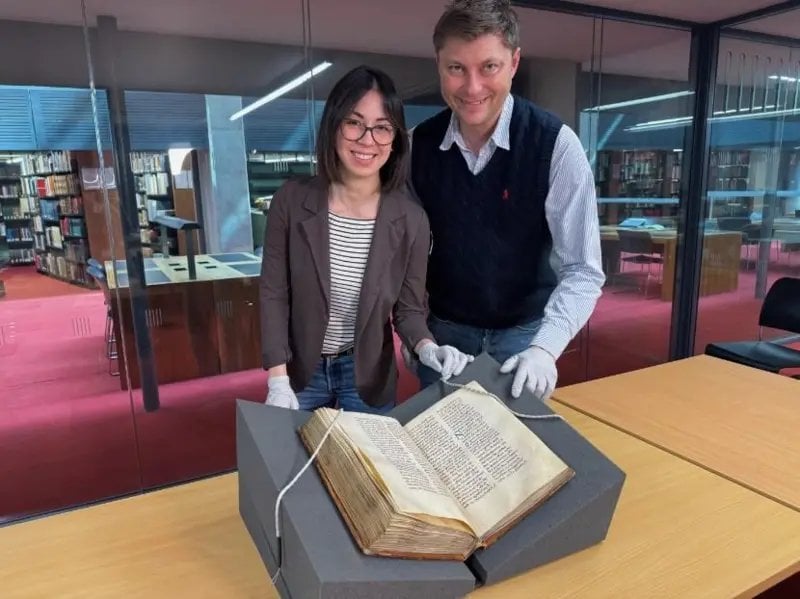
The discovery was made by Dr Elisabetta Magnanti and Dr Mark Faulkner, researchers from Trinity College Dublin. They uncovered the poem inside an old handwritten manuscript held at the National Central Library of Rome.
The poem, known as Caedmon’s Hymn, is more than 1,300 years old and contains just nine lines. It dates back to the late seventh century, during the Anglo-Saxon period.
According to tradition, Caedmon was a cow herder from Whitby in North Yorkshire who could not read or write. The hymn is said to have come to him after a religious dream.
A Latin version of the poem was later recorded in Ecclesiastical History of the English People, a major historical work written in the eighth century by the monk and scholar Venerable Bede.
Bede was one of the most important writers of early English history, and his work helped preserve many details about Anglo-Saxon England.
Experts believe this newly discovered Old English version was copied and translated by a monk in northern Italy sometime between the years 800 and 830.
That makes it the third-oldest surviving copy of Caedmon’s Hymn. The two older known copies are kept in Cambridge and in St Petersburg, Russia.
What makes the Rome manuscript especially interesting is the way the Old English version appears. In the other early copies, the main text is in Latin and the Old English poem appears only as a note. In this newly found version, however, the Old English poem is included within the main body of the manuscript.
Dr Mark Faulkner said the discovery is significant because so little Old English writing has survived from this early period. Most surviving Old English texts come from several centuries later, especially the tenth and eleventh centuries.
He explained that Caedmon’s Hymn is extremely rare because it links modern readers to the earliest stages of written English. As the oldest known poem in Old English, it is often seen as the starting point of English literature.
The newly uncovered copy may also change how scholars understand the importance of Old English poetry in the early medieval period.
According to Dr Faulkner, the find suggests that early readers valued English-language poetry highly, even at a time when Latin was the dominant written language of scholarship and religion.
The discovery was made by Dr Elisabetta Magnanti and Dr Mark Faulkner, researchers from Trinity College Dublin. They uncovered the poem inside an old handwritten manuscript held at the National Central Library of Rome.
The poem, known as Caedmon’s Hymn, is more than 1,300 years old and contains just nine lines. It dates back to the late seventh century, during the Anglo-Saxon period.
According to tradition, Caedmon was a cow herder from Whitby in North Yorkshire who could not read or write. The hymn is said to have come to him after a religious dream.
A Latin version of the poem was later recorded in Ecclesiastical History of the English People, a major historical work written in the eighth century by the monk and scholar Venerable Bede.
Bede was one of the most important writers of early English history, and his work helped preserve many details about Anglo-Saxon England.
Experts believe this newly discovered Old English version was copied and translated by a monk in northern Italy sometime between the years 800 and 830.
That makes it the third-oldest surviving copy of Caedmon’s Hymn. The two older known copies are kept in Cambridge and in St Petersburg, Russia.
What makes the Rome manuscript especially interesting is the way the Old English version appears. In the other early copies, the main text is in Latin and the Old English poem appears only as a note. In this newly found version, however, the Old English poem is included within the main body of the manuscript.
Dr Mark Faulkner said the discovery is significant because so little Old English writing has survived from this early period. Most surviving Old English texts come from several centuries later, especially the tenth and eleventh centuries.
He explained that Caedmon’s Hymn is extremely rare because it links modern readers to the earliest stages of written English. As the oldest known poem in Old English, it is often seen as the starting point of English literature.
The newly uncovered copy may also change how scholars understand the importance of Old English poetry in the early medieval period.
According to Dr Faulkner, the find suggests that early readers valued English-language poetry highly, even at a time when Latin was the dominant written language of scholarship and religion.