
Korean War, United States Army, United States - World War II Armed Forces, European Theater - World War II - Allied Command, U.S. Politics & Government - 1952-1961, World War II - Military Operations - General & Miscellaneous, Cabinet Members - 20th & 21s
Log in to track your reading progress.
Overview
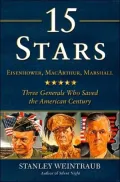
In the closing days of World War II, America looked up to three five-star generals as its greatest heroes. George C. Marshall, Dwight D. Eisenhower, and Douglas MacArthur personified victory, from the Pentagon to Normandy to the Far East. Counterparts and on occasion competitors, they had leapfrogged each other, sometimes stonewalled each other, even supported and protected each other throughout their celebrated careers. In the public mind they stood for glamour, integrity, and competence. But for dramatic twists of circumstance, all three -- rather than only one -- might have occupied the White House.The story of their interconnected lives opens a fascinating window onto some of the twentieth century's most crucial events, revealing the personalities behind the public images and showing how much of a difference three men can make. Marshall and MacArthur were contemporaries and competitors. Eisenhower was MacArthur's underling, then Marshall's deputy, before becoming MacArthur's counterpart as a supreme commander, Ike in Western Europe, MacArthur in the Pacific. Each of the three five-star generals would go on to extraordinary postwar careers: MacArthur as a virtual viceroy of Japan, overseeing its transition to a new constitutional democracy, and then leading the UN forces in the Korean War; Marshall as secretary of state, author of the Marshall Plan, and winner of the Nobel Peace Prize; Eisenhower as president.
Fifteen Stars presents the intertwined lives of these three great men against the sweeping background of six unforgettable decades, from two world wars to the Cold War. It is history at its most dramatic yet most personal -- a triumph for Stanley Weintraub, our preeminent military historian.
Editorials
BookPage
A well-researched book that thoroughly examines the lives of three American military icons.Desert Morning News
An interesting portrait of America's most prominent modern generals.New York Times Book Review
[An] object lesson in how even the most iron-willed president must always have strong, independent-minded commanders and, no less important, be willing to listen intently to them.News Journal
In 15 Stars, Weintraub hooks the reader early... One can clearly see Weintraub's penchant for finding greatness and hope wrapped within the darkness of war.Washington Post Book World
[A] stormy tale.Library Journal
The much-published Weintraub (arts & humanities, emeritus, Pennsylvania State Univ.; MacArthur's War: Korea and the Undoing of an American Hero) provides a detailed and absorbing gloss on the relationships among three extraordinary leaders. MacArthur dreamed of glory and expected the presidency; Marshall refused to plead for the battle command that would have made his name a byword; the gregarious Ike outstripped his former mentors. Fascinating reading; for all libraries.
—Edwin B. Burgess
Kirkus Reviews
All-purpose historian Weintraub (11 Days in December, 2006, etc.) charts the interlocking careers of three five-star generals who were giants in war and peace. Effectively delineating the arm's-length relationships among these towering figures, the author reserves his highest praise for George C. Marshall, who surely belongs with Benjamin Franklin and Alexander Hamilton on the short list of great American public servants never to have been president. Marshall was denied the sole job he ever coveted, command of the Normandy invasion, precisely because FDR found him indispensable, the only man in the army capable of simultaneously shielding Dwight D. Eisenhower in Europe and taming Douglas MacArthur in the Pacific. As the "organizer of victory," as Secretary of State and then Defense, Nobel Peace Prize recipient Marshall convincingly emerges from Weintraub's text as a man of uncommon modesty and integrity, the superior among his contemporaries. Marshall rapidly promoted the able Eisenhower, who labored for years unacknowledged under MacArthur, but Ike shabbily repaid his sponsorship by keeping silent during McCarthy-era attacks on Marshall's patriotism. Though he finds Eisenhower's easy postwar susceptibility to the blandishments of millionaire friends and hack politicians barely forgivable, Weintraub forthrightly credits Ike's mostly competent management of the European theater and his deft diplomacy among the Allies. It is the vain, self-pitying, self-promoting MacArthur who receives short shrift here. Justifiably finding MacArthur the man insufferable, Weintraub churlishly withholds credit where it's undoubtedly due. Although a deeply flawed character, MacArthur was hardly the constantmilitary blunderer depicted. His brilliant Inchon landing during the Korean War receives barely a page in this very long book, and his postwar resurrection of Japan seems more remarkable with each passing year, especially in light of America's similar project in today's Iraq. Personal bias notwithstanding, Weintraub ably uses his subjects' lives and work to reveal a great deal about their country's history in the second half of the 20th century. A complex narrative that properly elevates Marshall to his rightful place in the American pantheon.Book Details
Published
June 11, 2026
Publisher
New York : Free Press, c2007.
Pages
560
Format
Hardcover
ISBN
9780743275279