
World War I - General & Miscellaneous, World War I - Resolution & Aftermath, Peace Studies
Log in to track your reading progress.
Overview
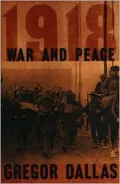
In 1918, renowned historian Gregor Dallas traces the transition from war to peace across Europe. In Berlin, the cabarets and beer halls are open while there is still shooting in the streets. In Paris, the peacemakers have assembled to draft the Treaty of Versailles and create the League of Nations. Washington is divided between those who want to open America to the world and those who would prefer the world to go away. A new theater season opens in London, where David Lloyd George holds new elections and reorganizes the War Cabinet and John Maynard Keynes worries about the debt. Moscow, still reeling from the Revolution of 1917, is a scene of desolation, but Lenin insists on setting up the Third International. The face of Europe was changed forever and the consequences of the peace in that autumn of 1918 would bear fruit twenty years later-when new horrors would await the next generation.This is a magisterial and compelling study in which Gregor Dallas weaves politics, ideas, social life, fears, and aspirations into a superb reconstruction of one of the great turning points in twentieth-century history.
Editorials
From Barnes & Noble
On a chilly night in November 1918, French troops, their eyes peeled for surprise attacks, spotted something fluttering in the foggy air of no-man's-land. It was a white flag, signaling the end of the Great War, a four-year conflict that had turned much of Europe into a gaping cemetery. Historian Gregor Dallas, author of the engaging The Final Act: The Roads to Waterloo, traces the transition from war to peace from the perspective of five capitals: Berlin, Paris, London, Moscow, and Washington. This ambitious narrative device sets the developing tensions of the postwar world in sharp relief.National Review
Tells the story of the war’s end in rich anecdotal detail.Publishers Weekly -
Dallas (The Final Act: The Roads to Waterloo) provides a meticulously detailed and intensive study of the years 1918-1919, when the Great War ended and the victors formulated a peace intended to resolve, once and for all, the underlying causes of the world's conflicts. In this, of course, the Allied leaders failed more completely than even the most pessimistic among them could have imagined. Dallas shows us how this failure arose from the irreconcilable objectives of the prevailing nations, from the mutual incomprehension of Lloyd George, Clemenceau and Wilson and from sheer lack of critical information. Germany had decisively lost the war, yet refused to acknowledge that fact even as it collapsed into political chaos. England and France clashed over reparations and over a military guarantee against future German aggression. For the United States, Wilson focused on vaporous abstractions at the expense of fact-based policy. In the East, Russia's war with itself and with Poland was just hitting stride. Dallas's strengths in his account of these pivotal years include his recognition of how geography influenced both the war's endgame and the fashioning of peace and his adroit sketches of the leading players at the peace conference. In addition to that of the heads of state, the author captures the work of the economists and administrators, such as John Maynard Keynes, Herbert Hoover and, from Germany, Walter Rathenau. These and so many others worked themselves to exhaustion to formulate peace, but, as Dallas demonstrates, chaos, bitterness and contradictory demands from all sides made a lasting peace impossible, and another war inevitable. Illus. (May 24) Copyright 2001 Cahners Business Information.Library Journal
Although numerous studies focus on the origins, course, and consequences of World War I, few examine the process of how the war ended. Dallas, an independent scholar living in France and author of 1815: Roads to Waterloo, analyzes how peace broke out in 1918. The strength of Dallas's narration is that he compares events and people in Berlin, Paris, London, Washington, DC, and Moscow. By analyzing how the ceasefire was arranged, who the major participants were, and how the general population learned about the armistice, we gain insight into the lingering bitterness of the peace and interwar years. Unfortunately, the comparative approach sometimes leads to oversimplification. For example, in his discussion of Britain's continental commitment, Dallas does not apparently make use of the work of Michael Howard, preferring instead to focus on the old axioms of naval power. Dallas also makes some factual errors Emperor Karl was not Franz Joseph's grandson, Bryn Mawr College is not in Connecticut that detract from his narrative. Despite this the book is well written and will interest a wide audience. Frederic Krome, Jacob Rader Marcus Ctr. of the American Jewish Archives, Cincinnati Copyright 2001 Cahners Business Information.Kirkus Reviews
A sweeping, swirling history of the end of WWI and the ensuing struggle for peace—and of the inadvertent and ineluctable construction of the foundation of WWII. Dallas (The Final Act: The Roads to Waterloo, 1997, etc.), born in London, educated at Berkeley, and now residing in France, is uniquely fit for this daunting task: He knows the languages, has explored the trenches, and has read the relevant published and archival documents. Consistent with his belief that history is local, he focuses on the geography of the north of western Europe, reminding us that "it is one large open plain. Europe's history is constructed on that fact." He begins his story as the war is ending. The US—despite its peculiar, disobliging insistence on keeping its forces independent—has finally arrived and, despite some initial failures, has provided the decisive boost in manpower and morale. Dallas crisply describes the military maneuvers that forced the German capitulation—and does not neglect the sanguinary details: "Horrors that would have been incredible to anyone before 1914 were the daily dose for soldiers on the front in 1918." He deftly shifts venues—London, Paris, Berlin, Moscow, Washington—letting us know what is happening and sketching portraits of many of the principal players, pointing his finger to events of significance not just in the geopolitical struggle but in the smaller, human ones as well. Thus, we watch the young poet Wilfred Owen fall during the final days; we see Lincoln Steffens interview Lenin. Still, it's the leaders whose stories grip us. Woodrow Wilson's myopic insistence on placing his League of Nations at the top of the armistice agenda,Lloyd George's physical agitation before he rose to speak, Clemenceau's determination to remain at work after surviving an assassin's bullet. And—most amazing—the Germans' refusal to acknowledge that they had even lost the war. Popular history at its best: a narrative with attitude—thoroughly researched, gracefully written. Possibly a classic. (62 b&w photographs, 4 maps)Book Details
Published
May 1, 2001
Publisher
Overlook Press
Pages
620
Format
Hardcover
ISBN
9781585671571