
Join Books.org — it's free

English, Scottish, & Welsh Fiction, Fiction - Children's Classics, Fiction - Fantasy & Magic, Fiction - Holidays & Festivals, Horror, Phases of Life - Fiction, Fiction - Religion & Beliefs, Motivations - Fiction, Holidays - Fiction, Fiction - Horror, Mons
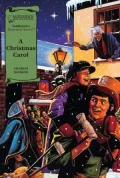
A Christmas Carol (Saddleback Classics Series) by Charles Dickens — book cover

A Christmas Carol (Saddleback Classics Series)

by Charles Dickens
Write a review
Log in to track your reading progress.

Overview

One of the best-loved and most quoted stories of "the man who invented Christmas"-English writer Charles Dickens-A Christmas Carol debuted in 1843 and has touched millions of hearts since. Cruel miser Ebeneezer Scrooge has never met a shilling he doesn't like. . .and hardly a man he does. And he hates Christmas most of all. When Scrooge is visited by his old partner, Jacob Marley, and the ghosts of Christmas Past, Christmas Present, and Christmas Yet to Come, he learns eternal lessons of charity, kindness, and goodwill. Experience a true Victorian Christmas!

A miser learns the true meaning of Christmas when three ghostly visitors review his past and foretell his future.

About the Author, Charles Dickens

Charles Dickens (1821-1870) used his fiction to criticize the injustices of his time, especially the brutal treatment

of the poor. He is also the author of Oliver Twist, Nicholas Nickleby, David Copperfield, A Tale of Two Cities, and Great Expectations. He was born in Portsmouth, England.

Patrick Stewart's career has conquered all mediums. His credits include the role of Professor Charles Xavier in all three X-Men films and as Captain Jean-Luc Picard in the highly popular television series Star Trek: The Next Generation. He is also a classically trained theatre actor and has been an Associate Artist of The Royal Shakespeare Company for more than forty years. In 1979 he won the Olivier Award for his performance in Anthony & Cleopatra and has since been nominated for both Golden Globe and Emmy awards for his roles in The Lion in Winter and Moby Dick. His one-man adaptation of Charles Dickens' A Christmas Carol won a New York Drama Desk Award for its sold out 1991 season on Broadway and an Oliver Award in London.

Biography

Born on February 7, 1812, Charles Dickens was the second of eight children in a family burdened with financial troubles. Despite difficult early years, he became the most successful British writer of the Victorian age.

In 1824, young Charles was withdrawn from school and forced to work at a boot-blacking factory when his improvident father, accompanied by his mother and siblings, was sentenced to three months in a debtor's prison. Once they were released, Charles attended a private school for three years. The young man then became a solicitor's clerk, mastered shorthand, and before long was employed as a Parliamentary reporter. When he was in his early twenties, Dickens began to publish stories and sketches of London life in a variety of periodicals.

It was the publication of Pickwick Papers (1836-1837) that catapulted the twenty-five-year-old author to national renown. Dickens wrote with unequaled speed and often worked on several novels at a time, publishing them first in monthly installments and then as books. His early novels Oliver Twist (1837-1838), Nicholas Nickleby (1838-1839), The Old Curiosity Shop (1840-1841), and A Christmas Carol (1843) solidified his enormous, ongoing popularity. As Dickens matured, his social criticism became increasingly biting, his humor dark, and his view of poverty darker still. David Copperfield (1849-1850), Bleak House (1852-1853), Hard Times (1854), A Tale of Two Cities (1859), Great Expectations (1860-1861), and Our Mutual Friend (1864-1865) are the great works of his masterful and prolific period.

In 1858 Dickens's twenty-three-year marriage to Catherine Hogarth dissolved when he fell in love with Ellen Ternan, a young actress. The last years of his life were filled with intense activity: writing, managing amateur theatricals, and undertaking several reading tours that reinforced the public's favorable view of his work but took an enormous toll on his health. Working feverishly to the last, Dickens collapsed and died on June 8, 1870, leaving The Mystery of Edwin Drood uncompleted.

Author biography from the Barnes & Noble Classics edition of David Copperfield.

Reviews

There are no reviews yet. Log in to write one.

Editorials

Publishers Weekly

Helquist's vision of the classic story depicts a hawkish Scrooge (who's a cadaverous shade of green) against a backdrop of bustling Victorian streets, with pleasing touches of detail, humor and a few frightful strokes. When the clock strikes one, announcing the arrival of the first ghost, the moon hangs in an unholy green sky, and the Ghost of Christmas Yet to Come stands in a tattered cloak, surrounded by eddying mists (but also draped with strings of Christmas lights). The eye-catching art makes a strong pairing to the accessible abridgment of Dickens's text. Ages 5–up. (Oct.)

School Library Journal

Gr 3 Up–Dickens’s cautionary tale of an embittered, stingy old man learning to be a happier, more giving person thanks to the intervention of four ghosts has long been fodder for holiday collections. From its stark opening spread (“MARLEY WAS DEAD”) to the final one with its much more cheerful winter scene, this year’s version, illustrated in Helquist’s darkly comic style, is one of the best. Some of that credit must go to Greenhut, who provided the abridgment. Sacrificing none of Dickens’s rich language, this retelling reads beautifully. The artist uses watercolor, pencil, and pastel to create cinematic artwork that contains amusing details; additionally, there are a number of pen-and-ink vignettes that help set the scenes. A winning combination of sparkling prose and exciting art.–Mara Alpert, Los Angeles Public Library

Book Details

Published
September 28, 2010
Publisher
Saddleback Educational Publishing
Pages
60
Format
Paperback
ISBN
9781599058931

More by Charles Dickens

Similar books