
Syntax, Afroasiatic (Hamito-Semitic) Languages
Log in to track your reading progress.
Overview
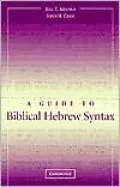
A Guide to Biblical Hebrew Syntax introduces and abridges the syntactical features of the original language of the Hebrew Bible or Old Testament. Scholars have made significant progress in recent decades in understanding Biblical Hebrew syntax. Yet intermediate readers seldom have access to this progress because of the technical jargaon and sometimes-obscure locations of the scholarly publications. This guide is an intermediate-level reference grammar for Biblical Hebrew. As such, it assumes an understanding of elementary phonology and morphology, and it defines and illustrates the fundamental syntactical features of Biblical Hebrew that most intermediate-level readers struggle to master. The volume divides Biblical Hebrew syntax, and to a lesser extent morphology, into four parts. The first three cover the individual words (nouns, verbs, and particles) with the goal of helping the reader move from morphological and syntactical observations to meaning and significance. The fourth section moves beyond phrase-level phenomena and considers the larger relationship of clauses and sentences.Editorials
From the Publisher
"Arnold and Choi have given to all who love the Hebrew Scriptures a clear, concise, correct and carefully prepared guide to Biblical Hebrew syntax, helping its students to interpret scripture accurately." Bruce K. Waltke, author of An Introduction to Biblical Hebrew Syntax"This is a highly useful book. It is brief and concise, yet is long enough to provide helpful and detailed descriptions (along with copious examples) that condense and distill the best of recent developments in Hebrew grammar and syntax... Students and instructors of Biblical Hebrew will want and need this volume on their shelves." Brent A. Strawn, Candler School of Theology, Emory University
"What a joy to read!...The concept of having something to put into students' hands after a year of grammatical study that attempts to lead them further into making sense of the Hebrew text is a wonderful and commendable goal....This is a long-overdue book." Roy L. Heller, Perkins School of Theology, Southern Methodist University
Book Details
Published
October 1, 2003
Publisher
Cambridge University Press
Pages
240
Format
Paperback
ISBN
9780521533485