
Join Books.org — it's free

Poetry - Rhymes, Nursery Rhymes & Fingerplays, Poetry - Basic Concepts & Education, Fiction - General & Miscellaneous, Alphabet
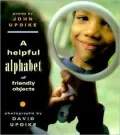
A Helpful Alphabet of Friendly Objects by John Updike; photographs by  David Updike β€” book cover

A Helpful Alphabet of Friendly Objects

by John Updike; photographs by David Updike
Write a review
Log in to track your reading progress.

Overview

This extraordinary alphabet book offers numerous rewards--poems that are by turns thoughtful and lively; crisp photographs that seem both familiar and new; and a fresh design to ensure repeated readings. Each poem and photograph describes ordinary things in language and images playfully accessible to preschoolers. Full color.

Poems and photographs present common objects for each letter of the alphabet.

About the Author, John Updike; photographs by David Updike

John Updike
Best known for a series of novels featuring Harry "Rabbit" Angstrom, John Updike was one of the 20th century's most distinguished American authors. Over the course of his long, prolific career, he garnered numerous literary awards, including two coveted Pulitzer Prizes!

Biography

With an uncommonly varied oeuvre that includes poetry, criticism, essays, short stories, and novels, two-time Pulitzer Prize winner John Updike helped to change the face of late-20th-century American literature.

Born in Reading, Pennsylvania, Updike graduated summa cum laude from Harvard in 1954. Following a year of study in England, he joined the staff of The New Yorker, establishing a relationship with the magazine that continued until his death in January, 2009. For more than 50 years, he lived in two small towns in Massachusetts that inspired the settings for several of his stories.

In 1958, Updike's first collection of poetry was published. A year later, he made his fiction debut with The Poorhouse Fair. But it was his second novel, 1960's Rabbit, Run, that forged his reputation and introduced one of the most memorable characters in American fiction. Former small-town basketball star Harry "Rabbit" Angstrom struck a responsive chord with readers and critics alike and catapulted Updike into the literary stratosphere.

Updike would revisit Angstrom in 1971, 1981, and 1990, chronicling his hapless protagonist's jittery journey into undistinguished middle age in three melancholy bestsellers: Rabbit Redux, Rabbit Is Rich, and Rabbit at Rest. A concluding novella, "Rabbit Remembered," appeared in the 2001 story collection Licks of Love.

Although autobiographical elements appear in the Rabbit books, Updike's true literary alter ego was not Harry Angstrom but Harry Bech, a famously unproductive Jewish-American writer who starred in his own story cycle. In between -- indeed, far beyond -- his successful series, Updike went on to produce an astonishingly diverse string of novels. In addition, his criticism and short fiction became popular staples of distinguished literary publications.

Good To Know

Updike first became entranced by reading when he was a young boy growing up on an isolated farm in Pennsylvania. Afflicted with psoriasis and a stammer, he escaped his self-consciousness by immersing himself in drawing, writing, and reading.

An accomplished artist, Updike accepted a one-year fellowship to study painting at the Ruskin School of Drawing and Fine Arts at Oxford University. He decided to attend Harvard University because he was a big fan of the school's humor magazine, The Harvard Lampoon.

One of the most respected authors of the 20th century, Updike won every major literary prize in America, including the Guggenheim Fellow, the Rosenthal Award, the National Book Award in Fiction, the O. Henry Prize, the American Book Award, the National Book Critics Circle Award, the Union League Club Abraham Lincoln Award, the National Arts Club Medal of Honor, and the National Medal of the Arts.

Reviews

There are no reviews yet. Log in to write one.

Editorials

Publishers Weekly - Publisher's Weekly

D is for Dog, and the author of Rabbit, Run makes much of it: "A dog is jumpier; its fur is clumpier... but rarely (compared to a cat) is it grumpier." PW gave a starred review to these 26 short poems illustrated with photographs: "This extraordinary alphabet book offers numerous rewards." Ages 5-8. (Mar.)

School Library Journal

K-Gr 2Updike's brief poems describe common everyday animals and objects from A-Z in language that is lively, succinct, and fun: ``A dog/is jumpier;/its fur/is clumpier;/its tail/is thumpier;/but rarely/(compared to a cat)/is it grumpier.'' The appealing full-color photos range from sharply focused closeups to reflections and sweeping action shots of adorable animals and photogenic children. Each page has a different colored background, and the layout is varied and creative. The ``Y'' page, for ``you,'' features kids of various ages and ethnic backgrounds playing, napping, and posing. This is not a memorable collection of poetry, but it's an entertaining selection that can be used as a concept book.Christine A. Moesch, Buffalo and Erie County Public Library, NY

Book Details

Published
July 1, 1994
Publisher
New York : A. Knopf : c1995.
Pages
40
Format
Hardcover
ISBN
9780679843245

Similar books