
Fiction - Entertainment & The Arts, Fiction - Miscellaneous People, Places & Cultures, Fiction - Asian People, Places & Cultures, Fiction - General & Miscellaneous
Log in to track your reading progress.
Overview
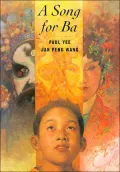
In the Chinese opera, men traditionally sing both male and female parts. Wei Lim's father, Ba, however, usually plays masculine characters and sings in a deep bass voice. But Wei's grandfather played female roles, and has secretly taught Wei to sing these difficult parts. When the New World's entertainments begin to cause a shrinking audience for the opera company, and Ba is forced to play female characters, which can help him learn to sing in such high tones? Color illustrations help bring Wei's tale, and this ancient art form, to life.
Editorials
Children's Literature
Paul Yee's many award-winning books have contributed greatly to awareness and understanding of the hardships and achievements of Chinese immigrants to North America. The unusual setting for this story is early twentieth-century Canada, where the traditional Chinese opera faces possible extinction before newer entertaiments like the motion picture. Wei Lim lives in an all-male community (female parts are sung by men) with his grandfather and father Ba, who, as a star of the opera, plays traditional warrior roles. Ba discourages Wei from learning to sing in what may be a dying form, but Grandfather secretly coaches the boy in the high vocal range needed for portraying a maiden or princess. When the opera troupe is at its lowest ebb, Ba must assume a female role, which he is unable to sing until Wei teaches him Grandfather's technique. Even after a triumphal performance, the future of the art remains in doubt. Accompanying this affecting story are paintings by Jan Peng Wang, Chinese-Canadian artist making his debut as children's book illustrator. With their subdued colors and pensive faces, the pictures project a nostalgic, even melancholy, sense of a faded era, as well as the transcending magic of theater. The artist has not quite mastered the art of picture book illustration; while many of the double-page spreads sweep the eye along, there are several very awkward transitions from page to page. Subject matter, historical context, and the subtle paintings make this fascinating tale suitable for readers older than the very young. 2004, Groundwood, Ages 8 up.— Barbara L. Talcroft
School Library Journal
Gr 3-5-This story is set in the early part of the 20th century, when Chinese immigrants to the Pacific coast struggled to keep the ancient art of Chinese opera alive. Motherless Wei lives with his father and grandfather, both of whom are opera singers. Ba always plays the part of a brave, powerful general; Grandfather, following Chinese tradition that kept women off the stage, used to play female roles. Although Wei longs to follow them onto the stage, Ba believes that there is no future for his son in this dying art form and refuses to instruct him. However, Grandfather secretly teaches young, high-voiced Wei the women's songs he sang long ago. After Grandfather returns to China, Ba's troupe hits hard times, and a shortage of performers forces him to play both general and lady. Using the skills Grandfather taught him, Wei coaches his father for the unfamiliar role, and then shares in his success on opening night. The illustrations, done in oils on textured canvas, realistically depict the characters as they look offstage, as well as in their traditional costumes and makeup. Double-page, soft-focused paintings, executed in muted colors, convey the mood of nostalgia and loss inherent in this backstage tale. Pair this story with Aaron Shepard's Lady White Snake (Pan Asian, 2001) and films of Chinese opera to introduce this art form, so central to traditional Chinese culture.-Margaret A. Chang, Massachusetts College of Liberal Arts, North Adams Copyright 2004 Reed Business Information.Kirkus Reviews
An unusual immigrant story offers a fascinating glimpse into an unfamiliar art form. In the Chinatown of a Pacific Rim city in perhaps the 1930s, a boy named Wei lives with his father and grandfather. Both are famous singers in the Chinese opera, where men perform all the parts, both male and female. Wei's father Ba will not teach him opera, for he feels there's no future in it. But Wei learns the high, clear female parts from his grandfather. Grandfather goes back to China one last time, and Wei's father goes on tour with the troupe. When Ba returns, he has to learn women's parts as the beleaguered troupe needs more versatility, and it is Wei who teaches him, based on grandfather's instruction. Wang uses paint beautifully in these illustrations, now letting the canvas texture through, now using the heft of the color to add gravity and sparkle. The images are fully realized paintings of the city, the home, and the theater, rich in costume and characterization. Especially suitable for older children and studies of immigrant life and culture. (Picture book. 7-10)Book Details
Published
April 1, 2004
Publisher
Groundwood Books
Pages
32
Format
Hardcover
ISBN
9780888994929