
U.S. Politics & Government - 1945 - 1989, U.S. Politics & Government - 1945 to Present, 20th Century American History - Politics & Government - General & Miscellaneous, Liberalism & Conservatism
Available on Bookshop
Write a review
Books.org participates in affiliate programs including Bookshop.org and the Amazon Services LLC Associates Program. We may earn a commission from qualifying purchases made through links on this page, at no additional cost to you.
Log in to track your reading progress.
Overview
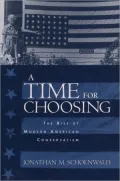
How did American conservatism, little more than a collection of loosely related beliefs in the late 1940s and early 1950s, become a coherent political and social force in the 1960s? What political strategies originating during the decade enabled the modern conservative movement to flourish? And how did mainstream and extremist conservatives, frequently at odds over tactics and ideology, each play a role in reshaping the Republican Party? In the 1960s conservatives did nothing less than engineer their own revolution. A Time for Choosing tells the remarkable story behind this transformation. In the first decade after the World War II, two broad branches of organized conservatism emerged: mainstream or electoral conservatism and extremist conservatism. By the end of the 1950s, both groups had grown dissatisfied with the Republican Party, yet they disagreed about how to create political change. Looking to private organizations as a means of exerting influence, extremists tapped the reserves of conservative discontent and formed maverick factions such as the John Birch Society. Mainstream conservatives, on the other hand, attempted to capture the GOP, seeking reform through the electoral and party systems. They "drafted" Barry Goldwater as their presidential candidate in 1964, and though he suffered a devastating defeat, the campaign electrified millions of Americans. Four years later, American conservatism, a perennial underdog in national politics, was firmly in the ascent. A Time for Choosing, making unprecedented use of archival material to document the strategies and influence of grassroots citizens' groups, provides the fullest picture yet of the way conservatism's two cultures combined to build a triumphant political movement from the ground up. Where previous accounts of conservatism's rise tend to speed from 1964 through the start of the Reagan era in 1980, A Time for Choosing explores in dramatic detail how conservatives took immediate action following the Goldwater debacle. William F. Buckley, Jr.'s 1965 bid for Mayor of New York City and Reagan's 1966 California governor's campaign helped turn the tide for electoral conservatism. By decade's end, independent "splinter groups" vied for the right to bear the conservative standard into the next decade, demonstrating the movement's strength and vitality. Although conservative ideology was not created during the 1960s, its political components were. Here, then, is the story of the rise of the modern conservative movement. Provocative and beautifully written, A Time for Choosing is a book for anyone interested in American politics and history in the postwar era.Editorials
Library Journal
Conservatism emerging as a political force to be reckoned with very well may be the most enduring counterculture movement of the Sixties. Schoenwald (humanities, Stanford) offers a thoroughly researched investigation of the love/hate relationship between mainstream Republican conservatism and extremist, rabid anti-Communist factions like the John Birch Society and how they merged in 1964 to nominate the conservative Arizona senator Barry Goldwater as the Republican Presidential candidate. While Goldwater proved to be the wrong man at the wrong time, Schoenwald demonstrates that Ronald Reagan was the right man at the right time just two years later when he was "surprisingly" elected governor of California. The conservative movement surpassed liberalism as the politics of choice for voters when its leaders and grass-roots workers discovered the limits of ideology, the importance of organization, and the necessity of getting out the vote. Although not as entertaining as Rick Perlstein's Before the Storm: Barry Goldwater and the Unmaking of the American Consensus (LJ 2/15/01), Schoenwald's is an excellent account of the spread of conservatism from 1957 to 1972. His study is especially strong in revealing the internal workings of the many splinter groups that the movement comprised during its formative years. Strongly recommended for larger public and academic collections. Karl Helicher, Upper Merion Twp. Lib., King of Prussia, PA Copyright 2001 Cahners Business Information.Book Details
Published
August 29, 2002
Publisher
New York ; Oxford University Press, 2001.
Pages
352
Format
Paperback
ISBN
9780195157260