
International Relations - General & Miscellaneous, Presidents of the United States - Biography, General & Miscellaneous Political Theory, U.S. Politics & Government - 1980-1989, U.S. Politics & Government - 1988-1993, U.S. Diplomatic Relations - History
Available on Bookshop
Write a review
Books.org participates in affiliate programs including Bookshop.org and the Amazon Services LLC Associates Program. We may earn a commission from qualifying purchases made through links on this page, at no additional cost to you.
Log in to track your reading progress.
Overview
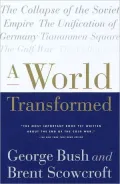
It was one of the pivotal times of the twentieth century--during George Bush's presidency, an extraordinary series of international events took place that materially changed the face of the world. Now, former President Bush and his national security advisor, Brent Scowcroft, tell the story of those tumultuous years.Here are behind-the-scenes accounts of critical meetings in the White House and of summit conferences in Europe and the United States, interspersed with excerpts from Mr. Bush's diary. We are given fresh and intriguing views of world leaders such as Mikhail Gorbachev, Boris Yeltsin, Margaret Thatcher, Helmut Kohl, and François Mitterrand--and witness the importance of personal relationships in diplomacy. There is the dramatic description of how President Bush put together the alliance against Saddam Hussein in the Gulf War. There are the intensive diplomatic exchanges with Beijing following the events of Tiananmen Square, and the intricate negotiations leading up to German reunification. And there is the sometimes poignant, sometimes grim portrayal of Gorbachev's final years in power.
A World Transformed is not simply a record of accomplishment; Bush and Scowcroft candidly recount how the major players sometimes disagreed over issues, and analyze what mistakes were made. This is a landmark book on the conduct of American foreign policy--and how that policy is crucial to the peace of the world. It is a fascinating inside look at great events that deepens our understanding of today's global issues.
From the Hardcover edition.
Editorials
Robert Kagan
. . .The novel construction of these memoirs — the two take turns telling their story — lifts them well above the monotony of other such accounts and produces a rounded picture. . .at least as seen from the White House.— Commentary
Michael Beschloss
R.. . .[T]he ex-President recalls dangerous days. . .It should leave little doubt how lucky we were that we had such a seasoned hand on the tiller at a time when foreign policy really counted.—Newsweek .
Fareed Zakaria
[A] book that is tightly limited in scope. . . .remarkably frank, intelligent and also readable, indeed at times gripping. . . .In explaining his foreign policy and justifying it, in his own piecemeal way, George Bush has finally found the vision thing. —The New York Times Book ReviewEugene V. Rostow
Among the finest expositions of modern American foreign policy since the time of Harry Truman. . .An excellent book. . .unique in form. . .[dealing with] potentially explosive crises. Any one of them, if badly managed, could have precipitated a third world war in a nuclear setting.— The Wall Street Journal
Library Journal
The former President and his national security adviser offer a behind-the-scenes look at his administration.Library Journal
The former President and his national security adviser offer a behind-the-scenes look at his administration.Booknews
The US President from 1989 to 1993 and his National Security Advisor explain how they brought the Evil Empire to its knees. They discuss negotiations and decision making relating to the collapse of the Soviet Union, the unification of Germany, Tiananmen Square, and the Gulf War. No bibliography. Annotation c. by Book News, Inc., Portland, Or.Robert Kagan
. . .[T]he novel construction of these memoirs -- the two take turns telling their story -- lifts them well above the monotony of other such accounts and produces a rounded picture. . .at least as seen from the White House. -- CommentaryMichael R. Beschloss
. . .[T]he ex-President recalls dangerous days. . .It should leave little doubt how lucky we were that we had such a seasoned hand on the tiller at a time when foreign policy really counted. -- NewsweekEugene V. Rostow
Among the finest expositions of modern American foreign policy since the time of Harry Truman. . .An excellent book. . .unique in form. . .[dealing with] potentially explosive crises. Any one of them, if badly managed, could have precipitated a third world war in a nuclear setting. -- The Wall Street JournalAdam Garfinkle
It reveals a wealth of detail about the main lines of U.S. foreign policy at the highest level during a most portentous period of our history. . .There is much high drama here [and] plenty even for experts to learn. -- Philadelphia InquirerUSA Today
. . .[R]eads like a limited memoir of a 'foreign policy President,' not a portrait of the well-rounded. . .career politician Americans knew as their 41st President . . . .It's hard to dispute one of Bush's own critiques of the work. He described it as a dry treatise to one interviewer.Fareed Zakaria
The most important book yet written about the end of the Cold War. . .Remarkable frank, intelligent and also readable, indeed at times gripping. -- The New York Times Book ReviewAndrew J. Bacevich
. . .[E]xposes the strategic illusions that currently blight American foreign policy. In that sense, it qualifies as required reading. -- National ReviewRichard Dunham
A memorable memoir. . .A compelling look at some very important historical developments. . .Remarkable candid. . .Supplemented with a series of revealing and heretofore unpublished excerpts from Bush's White House diaries. -- Business WeekKirkus Reviews
A surprisingly gripping account of the foreign policy crises and triumphs of the Bush years. The surprise lies not in the inherent drama of the events—the disintegration of the Soviet Union, the fall of the Berlin Wall, and Operation Desert Storm—but in the tension that the usually low-key Bush conveys. Bush and Brent Scowcroft, his national security advisor, contribute their own perspectives at different stages of the crises, with a more general narrative to complement their individual views. It's an unusual format that works well in conveying the pressures and the variety of opinions Bush had to take into account. The authors avoid too heavy a reliance on hindsight, and thus capture the tension and uncertainty of the moment. There is too much discretion in the analyses of most of those with whom the administration worked but great precision in dealing with their political needs: King Fahd of Saudi Arabia, for example, fearful of giving the U.S. military bases because of fears that the U.S. might leave as it did from Lebanon after the attack on the Marine base. One is left with great admiration for both Bush and Scowcroft. The president understood the importance of consultation and personal contact with allies and adversaries, and carried out that mission with a diligence and delicacy that may be unique in presidential annals. His stroking of difficult allies like Mitterand, including an invitation to stay at Kennebunkport, paid huge dividends. On the advice of Egyptian president Mubarak, he made contact with the rulers of even obscure Middle Eastern principalities, which was to pay off handsomely during Desert Storm. He conveys memorably just how difficult it was toassemble and keep together that coalition, while Mikhail Gorbachev looked desperately for some diplomatic stroke to restore his prestige, Saddam Hussein tried to use Israel to split the Arabs, and opponents argued that sanctions should be given more time. A nuanced and subtle evocation of the presidency in the middle of some of the greatest foreign policy crises of our time.Book Details
Published
December 7, 2011
Publisher
Knopf Doubleday Publishing Group
Pages
624
ISBN
9780307806598