
Zoology - General & Miscellaneous, Physiology, Physiology - Stimuli & Behavior, Animals & Habitats in Environmental Science, Ecology - General & Miscellaneous, Animals - Habitats & Behaviors - General & Miscellaneous, Animal Behavior & Psychology
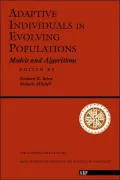
Adaptive Individuals in Evolving Populations: Models and Algorithms, Vol. 23
Richard K. Belew, Belew, Melanie Mitchell
Available on Bookshop
Write a review
Books.org participates in affiliate programs including Bookshop.org and the Amazon Services LLC Associates Program. We may earn a commission from qualifying purchases made through links on this page, at no additional cost to you.
Log in to track your reading progress.
Overview
The theory of evolution has been most successful explaining the emergence of new species in terms of their morphological traits. Ethologists teach that behaviors, too, qualify as first-class phenotypic features, but evolutionary accounts of behaviors have been much less satisfactory. In part this is because maturational ”programs” transforming genotype to phenotype are ”open” to environmental influences affected by behaviors. Further, many organisms are able to continue to modify their behavior, i.e., learn, even after fully mature. This creates an even more complex relationship between the genotypic features underlying the mechanisms of maturation and learning and the adapted behaviors ultimately selected.A meeting held at the Santa Fe Institute during the summer of 1993 brought together a small group of biologists, psychologists, and computer scientists with shared interests in questions such as these. This volume consists of papers that explore interacting adaptive systems from a range of interdisciplinary perspectives. About half of the articles are classic, seminal references on the subject, ranging from biologists like Lamarck and Waddington to psychologists like Piaget and Skinner. The other half represent new work by the workshop participants. The role played by mathematical and computational tools, both as models of natural phenomena and as algorithms useful in their own right, is particularly emphasized in these new papers. In all cases, the prefaces help to put the older papers in a modern context. For the new papers, the prefaces have been written by colleagues from a discipline other than the paper’s authors, and highlight, for example, what a computer scientist can learn from a biologist’s model, or vice versa. Through these cross-disciplinary ”dialogues” and a glossary collecting multidisciplinary connotations of pivotal terms, the process of interdisciplinary investigation itself becomes a central theme.Synopsis
A meeting held at the Santa Fe Institute during the summer of 1993 brought together a small group of biologists, psychologists, and computer scientists with shared interests in questions of evolution. This volume consists of papers that explore interacting adaptive systems from a range of interdisciplinary perspectives.
Book Details
Published
May 1, 1996
Publisher
Westview Press
Pages
552
Format
Paperback
ISBN
9780201483697