
Middle East - Diplomatic Relations with the U.S., Participation & Pluralism in Democracies, World Politics, U.S. Diplomatic Relations - General & Miscellaneous, Politics & Islam
Log in to track your reading progress.
Overview
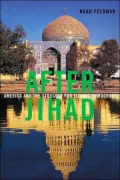
A lucid and compelling case for a new American stance toward the Islamic world.What comes after jihad? Outside the headlines, believing Muslims are increasingly calling for democratic politics in their undemocratic countries. But can Islam and democracy successfully be combined? Surveying the intellectual and geopolitical terrain of the contemporary Muslim world, Noah Feldman proposes that Islamic democracy is indeed viable and desirable, and that the West, particularly the United States, should work to bring it about, not suppress it.
Encouraging democracy among Muslims threatens America's autocratic Muslim allies, and raises the specter of a new security threat to the West if fundamentalists are elected. But in the long term, the greater threat lies in continuing to support repressive regimes that have lost the confidence of their citizens. By siding with Islamic democrats rather than the regimes that repress them, the United States can bind them to the democratic principles they say they support, reducing anti-Americanism and promoting a durable peace in the Middle East.
After Jihad gives the context for understanding how the many Muslims who reject religious violence see the world after the globalization of democracy. It is also an argument about how American self-interest can be understood to include a foreign policy consistent with the deeply held democratic values that make America what it is. At a time when the encounter with Islam has become the dominant issue of U.S. foreign policy, After Jihad provides a road map for making democracy work in a region where the need for it is especially urgent.
Editorials
The New York Times
Feldman's project in After Jihad is to focus on a more general question: how can political Islam and democracy be reconciled? The answer matters, he writes, because Islamism is one of the few vibrant intellectual movements alive today in the Muslim (especially Arab) world. Repressive governments have found it much harder to shut down mosques than political parties. — Jonathan D. TeppermanThe Washington Post
Noah Feldman has written a substantial and important defense of why America should support democratic reform and not the authoritarian status quo in much of the Muslim world. In the followup to the conflict in Iraq, no subject could be more timely. — Emran QureshiPublishers Weekly
Feldman is careful to distinguish his first book from some of the spate of recent works with the word "jihad" in the title, which contend that anti-Western, violent brands of Islam are growing in strength and bravado. Feldman argues, on the contrary, that September 11 and more recent sporadic attacks mark "the last, desperate gasp of a tendency to violence that has lost most of its popular support." Violent jihad, or struggle, he asserts, has lost its luster in the Muslim world except in cases of self-defense, and most Muslims find both Islamic ideals and democratic values appealing. The question then becomes, "Would democratically elected Islamic governments be good or bad for Western interests?" His answer is that we shouldn't fear the worst. Feldman, a professor at New York University's School of Law with a doctorate in Islamic thought from Oxford, notes that both Islam and democracy are based on human equality and are highly flexible, and disputes claims that they are incompatible. About a third of the book is taken up with overviews of Islam and democratic development in specific countries and regions, such as Iran and Indonesia; these chapters cover well-hashed territory, but make useful summaries for nonexperts. Diehard proponents of a separation between mosque and state may remain unconvinced that elected Islamic governments would support such liberal notions as women's rights or religious freedom. But the strength of Feldman's work lies in his consistent and simple reminder that the emergence of democracy in some countries will not necessarily bring about Islamist rule, and that suppressing it would itself be downright undemocratic. (Apr.) Copyright 2003 Reed Business Information.Library Journal
An NYU law professor with a doctoral degree in Islamic studies considers whether Islamic nations can also be democratic. Copyright 2002 Cahners Business Information.Kirkus Reviews
Lost cause, bright future, or something in between? A Rhodes scholar with a doctorate in Islamic thought surveys the prospects for democracy in countries dominated by Islam. Although Islamic fundamentalism, which Feldman (Law/NYU) also calls "political Islam" and "Islamism," has understandably grabbed the headlines, he insists that the possibility of a looser relationship between mosque and state exists. Democracy and Islam can clash, but they can also be synthesized. With subtlety and discernment, Feldman identifies the rhetoric of justice not only as a principal appeal of Islamic fundamentalism but as a potential bridge between the religion and democracy. Just as helpfully, he discusses the diverse conditions and histories that underlie Islam around the world. Oil-driven states, such as Saudi Arabia’s monarchy, offer little chance for peaceful change, since petrodollars eliminate the need for significant taxation and, consequently, the consent of the governed. In contrast, other governments have better odds of becoming more progressive; Jordan, for example, has been edging toward greater parliamentary participation under King Abdullah. It is difficult to argue with Feldman’s contention that American pressure on dictators such as Egypt’s Hosni Mubarak would stand in the best moral tradition of our foreign policy while also refuting anti-American sentiment. Yet his arguments for recognizing Islam’s "rich if imperfect history of tolerating intra-Islamic diversity of opinion on matters of religion" lose some persuasiveness because he fails to really acknowledge that the Koran and its interpretations are often as ambiguous as they are rich, giving rise to the sword as much as to peace. Moredevastating, the words "perhaps" and "maybe" appear so often that they begin to sound like wishful thinking. "Perhaps Islam has a greater capacity for flexibility and accommodation than Westerners tend to believe on the basis of incomplete information and nervous projections" is the kind of waffling that may well provoke the response, "Perhaps not." A sincere plea for the US not to let a Burqa Curtain descend on more Islamic countries, undercut by stolid academese and unduly rosy speculation.Book Details
Published
April 1, 2003
Publisher
New York : Farrar, Straus and Giroux, 2003.
Pages
260
Format
Hardcover
ISBN
9780374177690