
Historical Biography - Royalty & Nobility, Russia - Kings & Rulers - Biography, Imperial Russia - 1855-1881
Log in to track your reading progress.
Overview
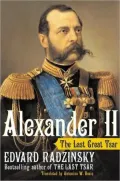
Edvard Radzinsky is justly famous as both a biographer and a dramatist, and he brings both skills to bear in this vivid, page-turning, rich portrait of one of the greatest of all Romanovs. Alexander II was Russia's Lincoln — he freed the serfs, promised a new, more liberal state for everyone, yet was brought down by a determined group of terrorist anarchists who tried to kill him six times before finally, fatefully, succeeding. His story proves the timeless lesson that in Russia, it is dangerous to start reforms, but even more dangerous to stop them. It also shows that the traps and dangers encountered in today's war on terrorists were there 150 years ago.
Editorials
From Barnes & Noble
Alexander II (1818-81) was Russia's most progressive tsar, the one Romanov ruler who could have delivered his people safely into the 20th century. But it was not to be: "Russia's Abraham Lincoln" was cut down on the streets of St. Petersburg by a Nihilist assassin before his reforms could be completed. Celebrated historian Edvard Radzinsky's biography of Alexander recaptures the turmoil of the time without losing sight of the "Tsar Liberator" at its center.Peter Baker
… Radzinsky's volume offers presidents and everyday readers alike a compelling account of one of Russia's most important figures, as well as a portrait of a critical, formative period in Russian history. Beyond the engaging narrative -- complete with all the spectacle, romance and intrigue that once dominated the court of St. Petersburg -- Radzinsky, a famous Russian playwright and television personality turned pop historian, presents a timely look at the roots of revolution and the nature of Russian society.— The Washington Post
Richard Lourie
Radzinsky's Alexander is an abstraction. The floorboards never creak beneath his weight.— The New York Times
Publishers Weekly
It's difficult to reform Russia, as popular historian Radzinsky shows in this lively examination of the czar best known for emancipating the serfs in 1861. Viewed as the most liberal of Russia's 19th-century czars, Alexander II (1818-1881) came to power in 1856 with the idea of bringing Russia into the modern age. But as Radzinsky (The Last Tsar) shows, his liberal reforms brought him nothing but trouble. Alexander came under attack from the right for being too liberal, and the left for not going far enough. He also had to curtail his reforms when faced with the need to fight foreign enemies. Radzinsky focuses much of the latter half of the book on the rise of left-wing populist movements-the book covers in depth the intellectual currents that swirled around Russia during Alexander's reign. Some frustrated leftists eventually turned to violence. After many failed attempts to assassinate Alexander, they eventually succeeded in 1881. Some readers may think Radzinsky provides too much familial background before launching into the czar's life, but his well-translated, readable prose will win over most readers interested in European history, and those looking for a cautionary tale on what Russia could face in the future. (Oct. 18) Copyright 2005 Reed Business Information.Library Journal
Best-selling author Radzinsky (e.g., The Rasputin File), a celebrated talk-show host and playwright in his native Russia, has written a biography for general readers that could double as a social and political history of prerevolutionary Russia. Its subject, who ruled Russia from 1855 to 1881, is best known for freeing the serfs but is characterized here as a "two faced Janus" because he spent the next 15 years keeping them in their place. Alexander II lived a charmed life, surviving at least six assassination attempts, but he remained caught between "the retrogrades," or conservative element in the government, and the revolutionaries. He was disliked by the liberals, who found his reforms inadequate and turned more radical in response. On March 1, 1881, he was finally assassinated by a handmade bomb thrown at his feet. Radzinsky sees Mikhail Gorbachev as a flawed reformer like Alexander II (looking backward while looking forward) and argues that the travails of 21st-century Russia have their roots in the vacillations of this tsar. Though scholars will find no new thesis here, the book is well researched, with a flowing narrative that weaves cultural history and biography very accessibly. Recommended for public libraries and general collections on prerevolutionary Russia.-Harry Willems, Southeast Kansas Lib. Syst., Iola Copyright 2005 Reed Business Information.Kirkus Reviews
Spare the knout and spoil the serf: an admiring biography of the 19th-century Russian ruler who ushered in modernizing reforms but was assassinated all the same. By Russian TV personality and pop historian Radzinsky's account, Alexander II was a soft touch, inclined to take after his mother, who was "frail and gentle, with azure eyes," rather than his father, "the indomitable giant" Tsar Nicholas, whose differences apparently "helped create the great harmony of their marriage." They may have found room to argue over young Alexander, who was altogether nice. When Nicholas asked his son what he would have done with a roomful of plotters arrested in the aborted Decembrist uprising, for instance, Alexander replied that he would forgive them in proper Christian fashion. His father replied scornfully, "Remember this: Die on the steps to the throne, but do not give up power!" When Nicholas finally died, Alexander immediately set about reforms that would be likened to the perestroika of the Gorbachev era, though, Radzinsky adds, "Starting reforms in Russia is dangerous, but it is much more dangerous to stop them." One reform was the abolition of serfdom, which, Radzinsky writes, occasioned only the briefest of honeymoons between the royals and the growing antimonarchical movement in Russia. The liberals of mid-19th-century Russia saw hope that Alexander would lead the country toward some version of social democracy, but Alexander had no intention of reforming himself out of a job, whereupon the pioneering nihilists and radicals who had been learning their politics from Marx and Bakunin-who make pleasing guest appearances, as does the ever-morose Fyodor Dostoyevsky-set about trying to do the tsarin, attempting to assassinate him on no fewer than six occasions and finally succeeding in March 1881. What the country got in return was a worse ruler, making nostalgia for Alexander a popular sentiment at the time of the revolution. Those who share that yearning for long-gone royals will find this portrait a pleasure.Book Details
Published
November 21, 2005
Publisher
New York : Free Press, c2005.
Pages
480
Format
Hardcover
ISBN
9780743273329