
Immigration & Emigration - Government Policy, Immigration & Emigration - United States
Log in to track your reading progress.
Overview
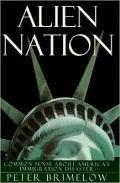
The United States is being engulfed by the greatest wave of immigration it has ever faced. The latest immigrants are different from those who came before. These newcomers are less educated, less skilled, more prone to trouble with the law, less inclined to share American culture and values, and altogether less likely to become Americans in name or spirit. Brimelow believes that we cannot continue to admit millions of legal and illegal immigrants if we wish to maintain our standard of living and our national identity. Unless we restore immigration to its more traditional role, he says, the United States risks being turned into an alien nation. According to Brimelow, our problems began with the enactment of the 1965 Immigration Act, a well-meant reform that has gone demonstrably wrong. Nobody anticipated that it would rob us of the power to determine who can and cannot enter our national family and that it would trigger an ethnic and racial transformation without precedent in history. It was an astonishing social experiment launched with no particular reason to expect success. As Brimelow points out, there is no example of a multicultural society that has lasted; many have disintegrated into racial and linguistic enclaves. Brimelow explodes all the myths about immigration. He explains why the current flood of immigrants does not benefit the economy. He shows how they are a drain on our social infrastructure and the environment. Conventional wisdom dictates that it is un-American to be against immigration, but we have repeatedly restricted immigration throughout our history. George Washington, Alexander Hamilton, and Thomas Jefferson were all wary of letting in too many newcomers. The United States is a lifeboat. Taking in so many unskilled workers and so many millions with no desire to share our American identity, we risk capsizing and sinking. Peter Brimelow's persuasive call for reform boldly defines one of the most important and sensitive issues of the decade.A senior editor at Forbes presents a stark and dramatic expose of America's out-of-control immigration crisis. Peter Brimelow--an immigrant himself--shows why he believes Americans must close the golden door, at least temporarily, to maintain their economic preeminence, social harmony, and national identity.
Editorials
Publishers Weekly -
Forbes senior editor Brimelow's alarmist, slashing anti-immigration manifesto is likely to stir debate. He maintains that the 1965 Immigration Act and its recent amplifications choked off immigration from northern and western Europe while selectively reopening U.S. borders to a huge influx of minorities from Third World countries. Many of these latter entrants are unskilled and require welfare support, and those who do work may adversely affect opportunities for poorer Americans, especially blacks, according to Brimelow. Because of multicultural programs, he charges, the new immigrants are not expected to assimilate, and thus they retain their separateness. Illegal immigration-two to three million entries a year-plus one million legal immigrants annually are causing, by his reckoning, an "ethnic revolution," because Asians, Hispanics, Middle Easterners and others shift America's balance away from the white majority, creating a strife-torn, multiracial society. Brimelow calls for an end to all illegal immigration, a drastic cutback in legal immigration, policies favoring skilled immigrants and elimination of all payments and free public education for illegals and their children.Publishers Weekly -
Forbes senior editor Brimelow's alarmist, slashing anti-immigration manifesto is likely to stir debate. He maintains that the 1965 Immigration Act and its recent amplifications choked off immigration from northern and western Europe while selectively reopening U.S. borders to a huge influx of minorities from Third World countries. Many of these latter entrants are unskilled and require welfare support, and those who do work may adversely affect opportunities for poorer Americans, especially blacks, according to Brimelow. Because of multicultural programs, he charges, the new immigrants are not expected to assimilate, and thus they retain their separateness. Illegal immigration-two to three million entries a year-plus one million legal immigrants annually are causing, by his reckoning, an ``ethnic revolution,'' because Asians, Hispanics, Middle Easterners and others shift America's balance away from the white majority, creating a strife-torn, multiracial society. Brimelow calls for an end to all illegal immigration, a drastic cutback in legal immigration, policies favoring skilled immigrants and elimination of all payments and free public education for illegals and their children. (Apr.)Library Journal
"Immigration has consequences," Brimelow (a Forbes senior editor and a contributor to the National Review) interjects repeatedly through this scattershot, argumentative tract against current immigration policy and practice. Claiming that the 1965 Immigration Act and later legislation in 1986 and 1990 have worsened a host of economic, political, and social problems in the United States, Brimelow cites supporters and critics alike of American immigration policy and his own interpretation of immigration statistics to disprove commonly held beliefs about immigrants' contributions to America, which he believes have been overemphasized. Brimelow argues that our environment is endangered, our public health threatened, our economy strained, our national unity diluted, and our politics fragmented-all by an immigration policy that is out of control and captive to a ruling "elite," which he associates with the liberal establishment and political correctness. Though Brimelow scores some points in his shrill attack, his highly politicized and provocative language-which often relies on ethnic stereotypes-makes this book a polemic guaranteed to rally the faithful and offend most others.-Jack Forman, Mesa Coll. Lib., San DiegoRay Olson
"E pluribus unum no more?" Like most other recent immigrants, former Englishman Brimelow thinks U.S. immigration policy badly needs reforming. Immigration is too high to begin with, he says, but also too many unskilled workers are coming, legally as well as illegally, as are too many persons whose ethnicities differ from the U.S. norm of predominantly European extractions. Brimelow maintains that besides the ill effects present immigration has on law enforcement, social service provision, public health, and the environment, it is undermining the sense of the U.S. as a nation. But we've always been "a nation of immigrants," you say? Brimelow documents that that is true only in that the American people, like the people of every other nation we know of, came from somewhere else. Moreover, throughout American history, immigration has occurred, not continuously, but in several waves that have alternated with long periods of assimilation--this is the pattern that built the nation and that the immigration tsunami touched off by the 1965 Immigration Act and complicated by the political resistance to assimilation known as multiculturalism has broken. The U.S. badly needs to drastically reduce immigration now, absorb the last 30 years' worth of new Americans, and rethink its immigration policies, Brimelow concludes, or it may dissolve into a bunch of smaller countries, in some of which democracy as we enjoy it will not survive. Writing in the magnetically readable, "sledgehammer" (his term) style of his principal employer, "Forbes", Brimelow is sure to fuel the debates on U.S. immigration policy in the months ahead.Book Details
Published
March 3, 1995
Publisher
New York : Random House, c1995.
Pages
327
Format
Hardcover
ISBN
9780679430582