
Energy & Utilities Industries, U.S. - Political Biography, State & Local U.S. Government, U.S. Politics - General & Miscellaneous, Environmental Politics, Political Theory & Ideology, United States History - Southern Region, Executive Branch, Economic Pol
Log in to track your reading progress.
Overview
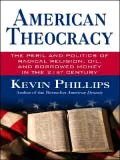
From the writer called our "modern-day Tom Paine,"an explosive analysis of the axis of religion, politics, and fiscal imprudence that threatens to destroy the nation.Unabridged CDs - 11 CDs, 13 hours
Editorials
From Barnes & Noble
Can any other critic of the Bush administration match Kevin Phillips's credentials? This veteran political and economic commentator literally wrote the playbook (The Emerging Republican Majority) that the GOP has been using successfully since the Nixon era. Now, with American Theocracy, he has composed an indictment of right-wing policies even more scathing and erudite than his American Dynasty. Phillips details the axis of political fundamentalism, petro-politics, and "borrowed prosperity" that are endangering America's future.Publishers Weekly
Scientists repeatedly prove the limited amount of fossil-based fuels left in the world and emphasize the environmental effects of using them. Yet many Republicans ignore science in the name of God while promoting a debt-driven consumer society. Debt, radical religion and fuel have been individual sources of expansion and destruction for many nations throughout history. Utilizing these precedents, Phillips provides detailed and troubling criticism of the United States' excessive dependence on and promotion of these three factors. Phillips predicts these practices will significantly diminish the power of the United States in international politics. In navigating this sometimes complicated book, Scott Brick delivers an outstanding performance. His command of the text will leave listeners believing that he wrote the book. His intensity matches the author's urgency while his emphasis proves a great value in determining the important information. Nonfiction audiobooks of this breadth often become cumbersome and daunting with information overload. But Brick leads his listeners with the gift of a master performer who knows his audience. While extras such as a time line, bibliography or character glossary could only improve this audiobook, the clarity of the text through the efforts of the author and narrator make it well worth the listen. Simultaneous release with the Viking hardcover (Reviews, Feb. 13). (Mar.) Copyright 2006 Reed Business Information.Library Journal
When Phillips wrote The Emerging Republican Majority almost 40 years ago, he correctly forecasted the electoral landscape of the United States for a generation and has ever since been among our most prominent political commentators. Now, however, in the latest of his many books, Phillips finds that the party he once served as strategist has become "a fusion of petroleum-defined national security; a crusading, simplistic Christianity; and a reckless credit-feeding financial complex." While some points made here overlap with points Phillips has already made elsewhere, e.g., in American Dynasty, his broadside against the Bush family, the most original part of this new book is his analysis of the "southernization" of American politics, an important component of his case here on oil and religion. If Phillips's political allegiance has changed over the decades, the sharpness of his observations and the historical depth and range of his arguments-as well as the wit and style gracing them-have not. His warning of an "Emerging Republican Theocracy" is sure to capture media attention and draw many readers. For all libraries. [See Prepub Alert, LJ 11/15/05.]-Robert F. Nardini, Chichester, NH Copyright 2006 Reed Business Information.Kirkus Reviews
A dazzling treatise on the collapse of Republican virtues under the fundamentalists and plutocrats united in the perfect storm of Bushism. Phillips (American Dynasty, 2004, etc.), the apostate former Republican strategist, once coined the term "Sun Belt" and envisioned the Southernization of American politics. He is now in the unhappy position of bearing witness to the birth of a Texas-fried, small-tent politics that blends religious orthodoxy and unwavering uncertainty in presidential infallibility with an economics predicated on indebtedness and extraction. The red state/blue state schism marks several old divides, he holds, one between "a preference for conspicuous consumption over energy efficiency and conservation," one between secularism and theocracy. Why would a good American encourage the latter? Well, a certain school holds that the Second Coming will not be triggered until theocratic rule is established in this most divinely favored of countries, after which, presumably, it will be up to the damned to sort through the ugly business of paying the debts and filling the tanks. Many of these divides are very old, Phillips observes, between "greater New England and the South"-save the polar reversal of the South now being Republican, the Northeast Democratic. As to the manifold manifestations of theocracy, few are subtle: Consider the Schiavo case, and unprecedented federal meddling in science education (with the executive's expressing a clear preference for so-called "intelligent design"), and the endless effort to undo various civil liberties. And the financialization of America? Again, writes Phillips, it's not subtle: "Never before have political leaders urged . . . large-scaleindebtedness on American consumers to rally the economy," to say nothing of an economy based on servicing debt rather than making anything useful-and, of course, on ever-scarcer oil. Other credit-happy theocracies, like Inquisition Spain, went bankrupt, collapsed under their own weight, disappeared from influence and view. Phillips's historical essay/polemic is provocative, though plenty of folks in Houston-to say nothing of Washington-won't like it at all.Book Details
Published
June 21, 2006
Publisher
Waterville, Me. : Thorndike Press, 2006.
Pages
777
Format
Hardcover
ISBN
9780786286935