
United States - World War I, World War I - General & Miscellaneous, 20th Century American History - World War I, U.S. Politics & Government - 20th Century, 20th Century American History - Politics & Government - 1900-1945, Allies - World War I
Available on Bookshop
Write a review
Books.org participates in affiliate programs including Bookshop.org and the Amazon Services LLC Associates Program. We may earn a commission from qualifying purchases made through links on this page, at no additional cost to you.
Log in to track your reading progress.
Overview
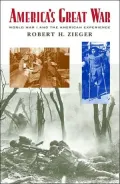
Recent bestsellers by Niall Ferguson and John Keegan have created tremendous popular interest in World War I. In America's Great War prominent historian Robert H. Zieger examines the causes, prosecution, and legacy of this bloody conflict from a frequently overlooked perspective, that of American involvement. This is the first book to illuminate both America's dramatic influence on the war and the war's considerable impact upon our nation. Zieger's engaging narrative provides vivid descriptions of the famous battles and diplomatic maneuvering, while also chronicling America's rise to prominence within the postwar world. On the domestic front, Zieger details how the war forever altered American politics and society by creating the National Security State, generating powerful new instruments of social control, bringing about innovative labor and social welfare programs, and redefining civil liberties and race relations. America's Great War promises to become the definitive history of America and World War I.Editorials
The Register
Overall, he more than meets his goal of providing a comprehensive and thought-provoking account of America's Great War experience for students and general readers.Military History
Zieger's discussion of the war's effects on the labor, civil rights, and feminist movements is superb. For those interested in the importance of the Great War in American History, this is a fine book.CHOICE
Zieger's deft historical synthesis of American society during WW I makes this volume informative for scholars and teachers, interesting for general readers, and especially useful for students. A superb synthesis, for all levels.Rocky Ford Daily Gazette
This is a concise, balanced, well written account of domestic, military and diplomatic aspects of the war which has greatly influenced American life in the ensuing eight decades. Zieger's book should be of interest to university students as well as general readers.Relevance
A thought-provoking work on the American experience during The Great War. This is an important work that adds to our understanding of the consequences of the First World War for the American people.Journal Of America's Military Past
This is an insightful examination of the American experience during World War I.Burton Kaufman
Three qualities have always characterized Robert Zieger's work: thorough familiarity with the pertinent literature; balanced and thoughtful analysis; and a graceful writing style. Each of these are evident in this volume.Kendrick Clements
The writing is lively, specific, and clear, but what impresses me most about this volume is its fairness. Zieger demonstrates that the strongest arguments from apparently clashing interpretations can be brought together to make a balanced, persuasive synthesis.William L. O'Neill
Robert Zieger, the distinguished historian of labor, has produced in America's Great War a superb overview of the national experience in World War I. He adds to diplomatic, political, and military history a close examination of the war's impact on women, minorities, and workers. He provides a lucid and fair-minded examination of how America helped the Allies win the war and lose the peace, and incisively analyzes Woodrow Wilson, the conflicted, obsessive self-defeating president around whom the entire war turned. Taking advantage of the latest scholarship, while weaving it skillfully into his own powerful narrative, Zieger has made this the best introduction yet to America's role in the defining event of the 20th Century.LeRoy Ashby
Prize-winning historian Robert H. Zieger has written another exemplary book—this one a judicious and insightful examination of the American experience during the Great War. In this eminently readable, thoughtful, and well-reseached work, he has produced a masterful synthesis that instructs, challenges, fascinates. A model of scholarly analysis, Zieger's study will engage the interest of specialists, students, and general readers alike.George H. Nash
World War I was the seminal cataclysm of the twentieth century. Professor Zieger's lucid volume is a discerning and provocative exploration of its consequences for the American people.Joseph A. McCartin
This well-crafted book takes the measure of America's experience in World War I both at home and on the European battlefield, gauging the lofty hopes with which so many Americans entered the fray and plumbing the tragic legacy of the war with equal care. The work of a historian who combines uncommon skill with a deeply humane vision, America's Great War provides readers the best single-volume introduction to its subject now in print.Patrick J. Maney
Brimming with sharp judgments and keen insights, Zieger's is the best book yet on the American experience in World War I. Zieger skillfully places the war in historical perspective, showing how the events of 1917-18 shaped the century to come. But he also conveys a sense of how the unfolding drama of war, with all its uncertainties, appeared to Americans at the time.James T. Patterson
Anyone looking for a first-rate book on the United States and World War I will derive great pleasure and insight from Robert Zieger's America's Great War. This is a concise, balanced, thoughtful, and well-written account of domestic, military, and diplomatic aspects of a war that has greatly influenced American life and institutions in the ensuing 80 years.Ellis W. Hawley
Robert Zieger's fascinating reexamination of America's World War I experience is deeply informed, gracefully and accessibly written, exceptionally insightful, and extraordinarily well balanced. It provides a masterful and much needed synthesis incorporating the best of recent research and interpretive rethinking. And, as intended, it will leave readers not only with a better understanding of what happened and why but also with a heightened sense of its historical importance, tragic implications, and enduring interest. It deserves a wide readership and extensive usage.Shelton Stromquist
This is a thoughtful, accessible and well-crafted analysis of the Great War's meaning and its impact on American society. Based on a scrupulous sifting of recent scholarship, Zieger's synthetic study brings to life both the geo-political significance of the war and its influence in reshaping the day-to-day lives of ordinary Americans.Labor History -
Skillfully blending sources—new and old, primary and secondary, print and electronic—as well as innovative methodologies and insights from an impressive variety of historical sub-disciplines, Zieger transforms what seem, at first glance, familiar stories into fascinating and challenging reinterpretations.Publishers Weekly -
In this captivating and clearly presented work, noted University of Florida historian Zieger (The CIO, 1935-1955) explores the relatively brief role of the U.S. in WWI. America's role was largely born of what Zieger portrays as President Woodrow Wilson's singularly idealistic, overtly Christian and arrogant world view that the U.S.--by virtue of its wealth and moral supremacy--alone could save Western civilization. Determined to use America's clout without involving American lives in a war that didn't threaten the country directly, Wilson very actively played the role of mediator among the warring parties for the first three years of the conflict. He finally asked Congress to declare war against Germany after German U-boats torpedoed neutral U.S. merchant ships. America's entrance into the war, therefore, set the stage for its future foreign relations policy, which until then had been primarily isolationist, and for the emergence of what Zieger calls a "national security state," with an active focus on developing the technology and securing and training the manpower necessary to maintain military readiness even during peacetime. This book also focuses on political battles fought on the home front on behalf of progressive causes in three crucial areas--race, labor and the "woman question." Growing unrest between workers and capitalists--and the growing disparity between wealth and poverty--led to an increase in labor union participation and more than 3,000 strikes, many of them violent. Leaders of the most prominent union, the AFL, pledged loyalty to the Wilson administration in return for the passage of legislation benefiting workers. Ziegler argues that America's stance in WWI was ultimately largely the result of one individual's vision, and that this involvement led to America's emergence as the world leader. 16 pages of b&w photos. (Nov.) Copyright 2000 Cahners Business Information.Kirkus Reviews
A traditional history of WWI, viewed typically as a major tragedy of the 20th century. Although the US didn't enter the war until 1917, Zieger (History/Univ. of Florida) reminds readers that American neutrality was never impartial. Businessmen and the educated elite tended to be Anglophiles, stirred up by floods of English propaganda accusing the Germans of outrageous acts, many fictional. The Germans helped by committing genuine outrages (burning the Louvain library, sinking the Lusitania, executing Edith Cavell), as well as by blunders reminiscent of the Keystone Cops (clumsy attempts at sabotage, the harebrained Zimmerman telegram). When the U-boat campaign finally goaded the US into war, initial response was less than spectacular. In contrast to the avalanche of American production that swamped the Nazis and Japanese, the Yanks fought in 1917—18 with artillery, transport, planes, and helmets supplied by their allies. American finance contributed more to victory than American troops. The war's depressing aftermath has been chronicled many times, but Zieger retells the story well. The Versailles Treaty was vindictive, he acknowledges, but no more so than other treaties forced on prostrate enemies. He also asserts that President Wilson's naïveté has been exaggerated. Wilson knew the Allies' vengeful demands made nonsense of his idealistic Fourteen Points but believed their acquiescence to a League of Nations justified all compromises. (Ironically, the US Senate failed to approve the League.) The war provided great benefits to American labor, women, and blacks, Zieger points out. Peace cancelled most benefits, but the good times planted seeds that bore fruitlater:blacks began their migration to northern cities; women got the vote; labor savored its first experience of a friendly government. Nothing new here, but the author knows his subject, and his lucid prose is a pleasure to read.Book Details
Published
October 28, 2000
Publisher
Lanham, Md. : Rowman & Littlefield Publishers, c2000.
Pages
320
Format
Hardcover
ISBN
9780847696444