
Modern Philosophy - 20th Century, Metaphysics, Mind, Philosophy of, Postmodernism, Science - General & Miscellaneous, Civilization - General & Miscellaneous
Available on Bookshop
Write a review
Books.org participates in affiliate programs including Bookshop.org and the Amazon Services LLC Associates Program. We may earn a commission from qualifying purchases made through links on this page, at no additional cost to you.
Log in to track your reading progress.
Overview
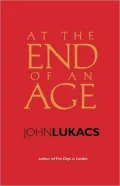
This compelling book is a deeply informed reflection on the nature of historical and scientific knowledge. Renowned historian Juhn Lukacs asserts that now, even at the end of the modern age, our understanding of the universe is based on what we fallible human beings have imagined and defined in a historical continuum; it is religion that is the source of the highest form of knowledge.Editorials
Booklist
Lukacs' little book . . . contains more information than shelves of other historical works.Matthew Rose
In a series of essays...Lukacs applies his unconnable good sense to the weighty question of man's place in the universe.—The Weekly Standard
Michael Korda
He brings to all [his writings] a Central European wit,charm,and realism.—Harper’s Magazine
National Post
[Lukacs has] the intuitions of a genius. He is very much a voice worth listening to.National Review
The author tackles weighty matters, but . . . some of his sly asides are among the best parts of the book.Publishers Weekly
"We have arrived at the stage of history when we must begin thinking about thinking itself. This is something as different from philosophy as it is from psycho-analysis," writes celebrated historian John Lukacs (Five Days in London, May 1940) in At the End of an Age, an extended essay on the problems of history. Continuing the argument he began in earlier books, Lukacs elaborates on his notion that we're at the end of the modern age that began with the Renaissance, and that this period calls for a reconsideration of the idea of objectivity in history and science, two disciplines that create rather than describe the world that they seek to understand. (May 7) Copyright 2002 Cahners Business Information.Library Journal
The author of over 20 books (Five Days in London: May 1940, etc.), Lukacs argues that our entire civilized "Modern Age" of science, reason, democracy, and capitalism is coming to an end. His own thoughts are especially influenced by the ideas of Pierre Duhem, Heisenberg, and Tocqueville. The author stresses the necessity of taking a historical perspective seriously, yet he ignores the obvious ramifications of organic evolution, which places human existence totally within a naturalistic (not idealistic) framework. Moreover, Lukacs is critical of giving priority to scientific knowledge and philosophical materialism. He even maintains that both this planet and our species are unique in the whole universe. Many readers will not accept his position that mind precedes and is the key to understanding matter. Furthermore, they will not readily dismiss the enormous contributions made by Darwin, Marx, Freud, and Einstein to a sound comprehension of and proper appreciation for mental activity, evolved humankind, and dynamic nature. Unfortunately, Lukacs neither speculates on what the emerging next age might be like nor discusses what could replace science and reason in the human quest for truths. Although insightful (particularly in its treatment of Adolf Hitler in terms of historical unpredictability), this esoteric book is suitable for larger academic library collections only. H. James Birx, Canisius Coll., Buffalo, NY Copyright 2002 Cahners Business Information.Book Details
Published
October 24, 2003
Publisher
New Haven : Yale University Press, cop. 2002
Pages
242
Format
Paperback
ISBN
9780300101614