
Join Books.org — it's free

20th Century American Literature - Post WWII - Literary Criticism, American & Canadian Letters, Literary Movements - General & Miscellaneous, Women's Biography - Letters, Artists - Women's Biography
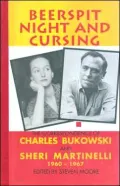
Beerspit Night and Cursing by Steven Moore — book cover

Beerspit Night and Cursing

by Steven Moore
Write a review
Log in to track your reading progress.

Overview

Unmasks the tough, street-smart persona of Charles Bukowski—America's "Ultimate Outsider"

  • Amazing letters filled with passionate, literary, and personal observation
  • Insights into the author of Tales of Ordinary Madness, Notes of a Dirty Old Man, and Run with the Hunted
  • Insights into Sheri Martinelli: the protege of Anais Nin, an accomplished painter, and the mistress of Ezra Pound Charels Bukowski's persona as the Dirty Old Man of American Literature is just that: a persona, a mask beneath which there was a man better read and more cultured than most people realize.

Sheri Martinelli was one of the favored few for whom Bukowski dropped the mask and engaged in serious discussion of literature and art, and for that reason the discovery and publication of his letters to her give us a more complete picture of this complicated man.

About the Author, Steven Moore

Charles Bukowski is one of America's best-known contemporary writers of poetry and prose, and, many would claim, its most influential and imitated poet. He was born in Andernach, Germany, and raised in Los Angeles, where he lived for fifty years. He published his first story in 1944, when he was twenty-four, and began writing poetry at the age of thirty-five. He died in San Pedro, California, on March 9, 1994, at the age of seventy-three, shortly after completing his last novel, Pulp.

Biography

During the course of his long, prolific literary career, Charles Bukowski was known as a poet, novelist, short story writer, and journalist. But it is as a cult figure, an "honorary beat" who chronicled his notorious lifestyle in raw, unflinching poetry and prose, that he is best remembered. Born in the aftermath of World War I to a German mother and an American serviceman of German descent, he was brought to the U.S. at the age of three and raised in Los Angeles. By all accounts, his childhood was lonely and unhappy: His father beat him regularly, and he suffered from debilitating shyness and a severely disfiguring case of acne. By his own admission, he underwent a brief flirtation with the far right, associating as a teenager with Nazis and Nazi sympathizers. After high school, he attended Los Angeles City College for two years, studying art, literature, and journalism before dropping out.

Although two of his stories were published in small literary magazines while he was still in his early 20s, Bukowski became discouraged by his lack of immediate success and gave up writing for ten years. During this time he drifted around the country, working odd jobs; fraternizing with bums, hustlers, and whores; and drinking so excessively that he nearly died of a bleeding ulcer.

In the late 1950s, Bukowski returned to writing, churning out copious amounts of poetry and prose while supporting himself with mind-numbing clerical work in the post office. Encouraged and mentored by Black Sparrow Press publisher John Martin, he finally quit his job in 1969 to concentrate on writing full time. In 1985, he married his longtime girlfriend Linda Lee Beighle. Together they moved to San Pedro, California, where Bukowski began to live a saner, more stable existence. He continued writing until his death from leukemia in 1994, shortly after completing his last novel, Pulp.

Bukowski mined his notorious lifestyle for an oeuvre that was largely autobiographical. In literally thousands of poems, he celebrated the skid row drunks and derelicts of his misspent youth; and, between 1971 and 1989, he penned five novels (Post Office, Factotum, Women, Ham on Rye, and Hollywood) featuring Henry Chinaski, an alcoholic, womanizing, misanthrope he identified as his literary alter ego. (He also wrote the autobiographical screenplay for the 1987 film Barfly, starring Mickey Rourke and Faye Dunaway.) Yet, for all the shock value of his graphic language and violent, unlovely images, Bukowski's writing retains a startling lyricism. Today, years after his death, he remains one of the 20th century's most influential and widely imitated writers.

Reviews

There are no reviews yet. Log in to write one.

Editorials

Booknews

Martinelli<-->a prot<'e>ge<'e> of Ana<:i>s Nin who was known in San Francisco in the late 1950s as the Queen of the Beats<-->was one of the few people, editor Steven Moore notes, for whom Bukowski regularly dropped his persona as Dirty Old Man of American Literature to engage in serious discussions of writing and art. In their seven years of corresponding, beginning in 1962, they shared intimate secrets and confessed to their attempts to find meaningful activity in life. All of their surviving letters are included in this compilation and are printed in full. Appendices include Martinelli's 1961 review of and Bukowski's contributions (a handful of poems and cartoons) to Martinelli's . Annotation c. Book News, Inc., Portland, OR (booknews.com)

Book Details

Published
March 1, 2001
Publisher
Santa Rosa, CA : Black Sparrow Press, 2001.
Pages
380
Format
Hardcover
ISBN
9781574231526

More by Steven Moore

Similar books