
Religion & State, Educational Reform, Christianity & Politics, Education Policies
Log in to track your reading progress.
Overview
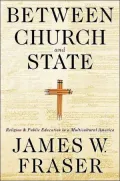
The relationship of religion and public education is, once again, a burning issue, with renewed debates about school prayer, ways to teach the Bible, and the relationship of religion and science. Though too few people know about it, battles over the proper relationship of religion to public education have gone on in the United States for as long as there have been public schools. At the most basic level, the debates about the relationship are debates about the nature of democratic culture. Who defines the dominant culture of the nation? How are minority rights and traditions protected? How are the deepest, and sometimes most diverse, issues of faith reconciled with the very public and common nature of schooling? How, after all, do we find a way for the school to be the public square where respectful and informed conversation can happen around beliefs which are both deeply held and radically different from individual to individual and sub-group to sub-group? Between Church and State explores these issues in terms of historical context, contemporary public policy debates, and practical steps for educators and other concerned citizens.Editorials
Publishers Weekly -
In a book that works better as history than as commentary (but attempts both), Fraser, a professor of history and education at Northeastern University, addresses the thorny relationship between religion and education in America. From Puritan times until recently, he demonstrates, Americans invited God into the classroom. But the terms of that invitation were never clear. Each colony organized its public schools around its own predominant faith, so nationhood brought a dilemma: Whose religion should be taught? The prominent Massachusetts educator Horace Mann offered a solution: use the Bible to inculcate a generic Unitarian faith. But this alienated other Protestants, not to mention freethinkers and Catholics. Later in the 19th century, the influx of Jews, Eastern European Catholics, African-Americans and Native Americans into public education made Mann's faith in a one-size-fits-all religiosity hopelessly na ve. Fraser goes to great lengths to show that even the simplest religious exercise, such as a start-of-the-schoolday prayer, could be unavoidably problematic for many faiths represented in America's classrooms. But while he acknowledges the "potential for cultural tyranny" by groups such as the Christian Coalition, he argues against the current style of purely secular public education and in favor of a "multicultural" approach in which all faiths would have a "place at the table." Fraser offers no specifics about the substance of such an approach, however. Nor does he explain how to avoid the divisiveness that nearly derailed religion-based public education in a less culturally diverse time, two centuries ago. (Aug.) Copyright 1999 Cahners Business Information.Library Journal
Ordained minister and professor Fraser (history, Northeastern Univ.) has penned a vibrant account of the historic tension between American public schools and established religion. The root of the problem, he argues, is society's inability to define precise and predictable boundaries for allowing religious expressions in schools. To demonstrate this, Fraser traces education history from the 17th through the 20th centuries, pausing occasionally to examine some key turning points, including the arrival of Catholic and Jewish immigrants and the introduction of the theory of evolution to school curriculum. Instead of resolving this conflict, Fraser contends, over time we've forged an uneasy truce whereby public education is, for the most part, devoid of any religion at all. The result, he suggests, is intellectual and spiritual impoverishment. Fraser's work is best read for historical perspective; he proposes few concrete policy suggestions. Still, it is a lively and timely history. Recommended for most public libraries.--Steven Anderson, Gordon Feinblatt Rothman Hoffberger & Hollander, Towson, MD Copyright 1999 Cahners Business Information.Booknews
Fraser (history and education, Northeastern U.) examines the historical context of today's battles over religious versus secular education in the public schools, offering the framework of democratic multiculturalism as a means of accepting different beliefs and practices in the public school environment, and providing practical steps for educators and citizens. Annotation c. Book News, Inc., Portland, OR (booknews.com)Book Details
Published
August 1, 1999
Publisher
New York : St. Martin's Press, c1999.
Pages
252
Format
Hardcover
ISBN
9780312216368