
Medical Ethics, Biology - General & Miscellaneous, Ethics & Moral Philosophy - Applied - Bioethics/Medical, Philosophy of Science - General & Miscellaneous
Log in to track your reading progress.
Editorials
From The Critics
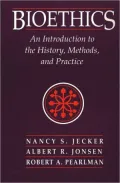
Reviewer: Glenn C. Graber, PhD(University of Tennessee at Knoxville)Description: This collection of essays is divided into three parts, each with an introduction by one of the editors. The history part (introduced by Jonsen) contains 13 essays on such themes as organ transplantation, experimentation, terminating treatment, and bioethics as a discipline; the methods part (introduced by Jecker) has 15 essays; the practice part (introduced by Pearlman) has 16 selections, including bits from state and federal statutes and professional association statements as well as scholarly discussions of ethics committees and ethics consultation.
Purpose: As the subtitle suggests, the book's purpose is to introduce the history of bioethics and its methodologies and techniques for carrying ethical analyses into the various settings in which healthcare is practiced.
Audience: The editors claim the book is intended for students at four levels: college undergraduates, medical students, graduate students, and healthcare professionals in continuing education.
Features: Most of the essays in the first part are indeed classics. However, not only are some key classics omitted, but whole topics are excluded. For example, I would contend that conceptions of the practitioner-patient relationship is a foundational topic, yet neither Veatch's classic essay sketching models of the relationship nor any other systematic treatment is included. Attention to the cultural context of bioethics in the method and the practice parts offer an important addition to bioethics. The essays, as well as the introductions, are mostly clear, free of unexplained jargon, and comprehensible even to those without much background in philosophy or bioethics.
Assessment: I don't know another book that purports to cover all three topics that this book takes on, although most introductory texts have always included a summary of underlying principles, and most now include some attention to the practice dimension of bioethics in legislation, professional position statements, and the workings of ethics committees and ethics consultants. One would expect the material in the practice section to be up-to-date, but there is as much or more material here from the 1970s than from the 1990s, and most comes from the mid- to late 1980s. I fear this book tries to cover too much ground to do any of it very satisfactorily.
Glenn C. Graber
This collection of essays is divided into three parts, each with an introduction by one of the editors. The history part (introduced by Jonsen) contains 13 essays on such themes as organ transplantation, experimentation, terminating treatment, and bioethics as a discipline; the methods part (introduced by Jecker) has 15 essays; the practice part (introduced by Pearlman) has 16 selections, including bits from state and federal statutes and professional association statements as well as scholarly discussions of ethics committees and ethics consultation. As the subtitle suggests, the book's purpose is to introduce the history of bioethics and its methodologies and techniques for carrying ethical analyses into the various settings in which healthcare is practiced. The editors claim the book is intended for students at four levels: college undergraduates, medical students, graduate students, and healthcare professionals in continuing education. Most of the essays in the first part are indeed classics. However, not only are some key classics omitted, but whole topics are excluded. For example, I would contend that conceptions of the practitioner-patient relationship is a foundational topic, yet neither Veatch's classic essay sketching models of the relationship nor any other systematic treatment is included. Attention to the cultural context of bioethics in the method and the practice parts offer an important addition to bioethics. The essays, as well as the introductions, are mostly clear, free of unexplained jargon, and comprehensible even to those without much background in philosophy or bioethics. I don't know another book that purports to cover all three topics that this book takes on,although most introductory texts have always included a summary of underlying principles, and most now include some attention to the practice dimension of bioethics in legislation, professional position statements, and the workings of ethics committees and ethics consultants. One would expect the material in the practice section to be up-to-date, but there is as much or more material here from the 1970s than from the 1990s, and most comes from the mid- to late 1980s. I fear this book tries to cover too much ground to do any of it very satisfactorily.3 Stars from Doody
Book Details
Published
January 30, 1997
Publisher
Boston : Jones and Bartlett Publishers, c1997.
Pages
416
Format
Paperback
ISBN
9780763702281