
Biology & Life Sciences, Zoology
Log in to track your reading progress.
Overview
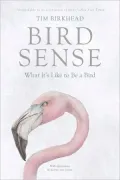
What is going on inside the head of a nightingale as it sings, and how does its brain improvise? How do desert birds detect rain hundreds of kilometers away? How do birds navigate by using an innate magnetic compass? Tracing the history of how our knowledge about birds has grown, particularly through advances in technology over the past fifty years, Bird Sense tells captivating stories about how birds interact with one another and their environment.
Never before has there been a popular book about how intricately bird behavior is shaped by birds' senses. A lifetime spent studying birds has provided Tim Birkhead with a wealth of fieldwork experiences, insights, and a unique understanding of birds, all firmly grounded in science. No one who reads Bird Sense can fail to be dazzled by it.
Editorials
Publishers Weekly
With clear gusto for his subject, animal behavior expert Birkhead (The Wisdom of Birds) breaks down what it might be like to see, hear, touch, taste, and smell as a bird. Tracing the insights, clever experiments, and surprise contributions that have helped debunk myths about birds’ senses, he takes us to Caripe, Venezuela, where a Harvard undergrad discovered that the cave-dwelling guácharo can navigate in total darkness via echolocation, and introduces us to Betsy Bang, the amateur ornithologist who persuaded the scientific community in the 1960s that birds can smell. After walking us through the five familiar senses that birds share with humans, he also shows how they may be able to orient themselves by the earth’s magnetic field using magnetite crystals within their beaks or even by seeing the field, the way we might a cloud or a tree. And he considers less tangible feelings, too. Although little is known about birds’ emotions, Birkhead makes reasonable behavior-based guesses about what a bird might feel when glimpsing a predator, losing a skirmish with a rival, or reuniting with a mate. The well-organized book takes pains to explain any avian jargon, making for an uncomplicated, entertaining read perfect for birdwatchers and animal enthusiasts. Agent: Felicity Bryan, Felicity Bryan Associates (U.K.). (May)Library Journal
This book helps readers understand what it's like to be something else—in this case, a bird. Ornithologist Birkhead (animal behavior & history of science, Univ. of Sheffield, UK; The Wisdom of Birds: An Illustrated History of Ornithology) writes about avian senses, with chapters on seeing, hearing, touch, taste, smell, magnetic sense, and emotions. He illustrates the history of scientific thought regarding birds' senses. Birkhead argues that it is difficult for humans to imagine themselves as birds because birds see a different ultraviolet spectrum, hear at higher frequencies, and somehow sense the earth's magnetic field. Moving among field locations (e.g., New Zealand, Florida, Atlantic islands), he illustrates the abilities of birds and their survival techniques, and, in the postscript, describes how all their senses function together. VERDICT Birkhead provides fascinating information for birders and naturalists, but his story often lacks smooth transitions between topics. His jargon may be unfamiliar to nonbirders, and because the author is British some terminology is different from American usage. Still, birders, naturalists, animal scientists, and students will be interested.—Sally Bickley, Del Mar Coll. Lib., Corpus Christi, TXKirkus Reviews
Birkhead (Animal Behavior and the History of Science/Univ. of Sheffield; The Wisdom of Birds: An Illustrated History of Ornithology, 2008, etc.) looks at the adaptive significance of bird behavior. A lifetime spent in ornithological research and old-fashioned bird-watching has convinced the author that "we have consistently underestimated what goes on in a bird's head." He describes how using the latest available tools, neurobiologists have uncovered new aspects of bird perception--e.g., the fact that female birds that see in the ultraviolet range chose mates on the basis of characteristics we can't directly perceive such as plumage markings. Even more fascinating, Birkhead explains that some birds "tend to use their right eye for close-up activities like feeding and the left eye for more distant activities such as scanning for predators." Another unexpected discovery which he hopes may prove relevant to the treatment of neuro-degenerative brain disease in humans is the plasticity of the brains of birds that live in temperate regions. As the days shorten with the approach of winter, the birds' brains shrink; conversely, increasing daylight triggers a hormone release resulting in an increase in brain size. This is correlated to the great mental activity required as new songs are acquired, mating occurs and nests are protected from predators. Another exciting discovery is the evidence of sensitive areas on their tongues and beaks, which enable them to preen in a manner similar to chimpanzee grooming. While Birkhead recognizes the problem of anthropomorphic interpretations of animal behavior, he describes a colleague's observation of birds engaging in an intense 17-minute greeting ceremony after being separated, behavior that suggested a human reunion. He admits to finding it tempting to infer that "birds experience similar pleasurable emotions." An entertaining book guaranteed to bring pleasure to bird-watchers that will also fascinate students contemplating a career in ecology.Book Details
Published
May 21, 2013
Publisher
Bloomsbury USA
Pages
288
Format
Paperback
ISBN
9781620401897