
Foreign Economic Relations - United States, Globalization, World Politics, 20th Century American History - Relations - General & Miscellaneous, World History - General & Miscellaneous, U.S. Diplomatic Relations - History
Log in to track your reading progress.
Overview
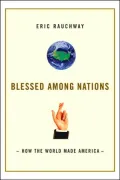
Nineteenth-century globalization made America exceptional. On the back of European money and immigration, America became an empire with considerable skill at conquest but little experience administering other people's-or its own-affairs, which it preferred to leave to the energies of private enterprise. The nation's resulting institutions and traditions left America immune to the trends of national development and ever after unable to persuade other peoples to follow its example. Blessed Among Nations concisely traces how, from the mid-1800s to the early 1900s, the world allowed the United States to become unique, and with brilliant nuance reminds us that we elide at our peril what differentiates America from other nations.About the Author:
Eric Rauchway teaches at the University of California, Davis
Editorials
Library Journal
The furor created in the United States by recent demonstrations on behalf of illegal immigrants makes Rauchway's analysis of America's early experiences with a global community especially timely. Rauchway (history, Univ. of California, Davis; Murdering McKinley: The Making of Theodore Roosevelt's America) posits that the United States became quintessentially "American," i.e., an economic powerhouse, in the years between the Civil War and World War I. In a staunchly unbiased fashion, he draws upon events during those years that made the United States the favored recipient of foreign capital investment. Cheap immigrant labor played a central role in the building of America, while other countries spent far more on the social welfare of their citizens than did the United States. Yet the influx of labor and capital did not make America more like other nations but instead more distinctive; it came to see itself, in President Wilson's phrase, as "blessed among nations," a concept that fostered the smug isolationism it abandoned when the United States was forced to enter World War I and become a major player in world affairs. Rauchway believes that the United States, by virtue of its standing among nations, has the obligation to maintain a commitment to globalization rather than to regard it as a self-regulating mechanism. An excellent addition for all academic and large public libraries. Peter R. Latusek, Stanford Graduate Sch. of Business Lib., CA Copyright 2006 Reed Business Information.Kirkus Reviews
Laying the groundwork for American empire was an international enterprise-so why doesn't the world want to be American?"The earth's people have more often envied than imitated America," writes Rauchway (History/UC Davis; Murdering McKinley, 2003), preferring parliamentarianism and welfare statism to republicanism and laissez-faire. To find out why, Rauchway examines America's rise to empire, which occupied the years between 1865 and 1917. During that time, he writes, America received both financial and human capital from abroad; the working class was predominantly immigrant, as was the army that tamed the western frontier, while huge flows of European cash into the post-Civil War economy made an industrial super-revolution possible, leading to a manifold increase in the nation's wealth. Yet Americans refused to do the things that newly wealthy countries do-namely, invest in public infrastructure and build social-welfare institutions and mechanisms. Rauchway observes that just before WWI, America's army was smaller than Ethiopia's, while "relative to the size of its economy it had a smaller government than the Netherlands"; he reckons that at least some of the refusal to build a welfare state had precisely to do with the fact that the working class "appeared visibly to consist of people from other countries," leading native-born Americans to look the other way when issues of, say, occupational safety and labor exploitation arose. Our laissez-faire ways seemed particularly problematic when it came time to raise an army to fight overseas, leading to the creation of particularly inept bureaucracies, for "routine competence simply did not lie within the experience of Americans who had reliedfor years on an incidentally benevolent world to take care of them." And when it came time to protect the world economy with American initiatives after the armistice, Americans failed to come through, yielding worldwide depression-good reason to avoid imitating the American way of life. Given the current reliance on foreign capital and immigrant labor, Rauchway's book is right on time and right on target.From the Publisher
"Rauchway's book is right on time and right on target." —Kirkus Reviews "Provocative . . . Blessed Among Nations combines the same fluid writing style, bold interpretive approach, and ambitious agenda that made the work of mid-twentieth-century historians like Richard Hofstadter, Arthur Schlesinger, Jr., and C. Vann Woodward so important and so broadly relevant." —American HeritageBook Details
Published
June 27, 2006
Publisher
New York : Hill and Wang, 2006.
Pages
256
Format
Hardcover
ISBN
9780809055807