
Education - United States - History, Urban Sociology - General & Miscellaneous, United States - Ethnic & Race Relations, Education - Political Aspects, Rural & Urban Settings, Educational Reform
Available on Bookshop
Write a review
Books.org participates in affiliate programs including Bookshop.org and the Amazon Services LLC Associates Program. We may earn a commission from qualifying purchases made through links on this page, at no additional cost to you.
Log in to track your reading progress.
Overview
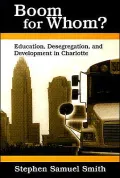
Bringing a new perspective to Charlotte's landmark school desegregation efforts, Stephen Samuel Smith provides a multi-faceted history of the nationally praised mandatory busing plan and the court battle that led to its ultimate demise. Although both black and white children benefited from busing, its most ongoing consequences were not educational, but the political and economic ones that served the interests of Charlotte's business elite and facilitated the city's economic boom. Drawing on urban regime theory, Smith shows how busing enhanced civic capacity and was part of a political alliance between Charlotte's business elite and black political leaders. But the rising tide of civic capacity that resulted from both this alliance and school desegregation, Smith indicates, has done much more to lift the yachts of Charlotte's business elite than the African American dinghies trailing behind. Thus, this account of Charlotte's history has national implications for desegregation, urban education, efforts to build civic capacity, and the political involvement of the urban poor.Author Biography: Stephen Samuel Smith is Professor of Political Science at Winthrop University.
Book Details
Published
April 1, 2004
Publisher
State University of New York Press
Pages
368
Format
Paperback
ISBN
9780791459867