
Economic Policies, Economic Theory & Schools of Thought, U.S. Politics in the Post Cold-War Era, Professional Finance & Investing, Economic History, United States History - 20th Century - 1945 to 2000, Economics & Politics, Macroeconomics
Available on Bookshop
Write a review
Books.org participates in affiliate programs including Bookshop.org and the Amazon Services LLC Associates Program. We may earn a commission from qualifying purchases made through links on this page, at no additional cost to you.
Log in to track your reading progress.
Overview
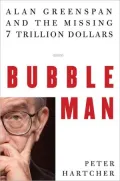
The destructive legacy of the most powerful man in the world: Alan Greenspan, chairman of the Federal Reserve.In this eye-opening account, Peter Hartcher reexamines the achievements of Alan Greenspan, the man who presided over the 1990s stock-market bubble—perhaps the biggest speculative frenzy in history—and walked away when it came crashing down, with his reputation apparently unscathed. The U.S. economy is still struggling with the fallout from Greenspan's tenure, which includes a bubble in housing prices, a rocky recovery, and a vast federal deficit. His mistakes live on, as does the question of what to do about bubbles.
Hartcher's careful investigation of the most financially expensive event in American history results in a gripping tale of failed leadership, excess, and the bizarre politics behind the world's most powerful economy.
Editorials
Publishers Weekly
Former Federal Reserve chairman Alan Greenspan's famous 1996 pronouncement that an "irrational exuberance" had gripped the American stock market was premature; the markets continued to climb, reaching an exceptional peak in March 2000 before sliding into a $7.8 trillion collapse. Hartcher (author of The Ministry and an editor at the Sydney Morning Herald) turns his attention to the culprits behind "the madness that was the Great American Bubble"-what was in purely monetary terms, the single costliest event in American history. The author blames corporations, Wall Street, the government and the media, but chief among his targets is Greenspan himself, whom Hartcher indicts for keeping interest rates low and investors' attitudes cheery. In this account, Greenspan's retreat from the critical position he staked in 1996, in the face of political opposition and public mania, earns him a decisive share of responsibility for the bubble and its consequences. Equal parts revisionist history, economics lesson and admonitory polemic, the book briskly moves through complex concepts with illustrative examples and straightforward analysis. While the text is occasionally repetitive (e.g., frequent mention of the crash of 1929), Hartcher's brisk, lively approach transforms a potentially dry dissection of monetary policy into an engaging cautionary tale. (May) Copyright 2006 Reed Business Information.Library Journal
Australian journalist Hartcher (The Ministry) has written a probing account of the 2000-01 bursting of the U.S. stock market bubble, which resulted in the loss of some $7 trillion. In attempting to assign some responsibility, Hartcher focuses on former Federal Reserve chair Alan Greenspan, who he believes had a significant role in bringing about this financial catastrophe. While acknowledging many of Greenspan's achievements, Hartcher calls Greenspan the "Machiavelli of monetary policy" and criticizes his deliberate inaction, especially in the period leading up to and during the market's collapse. He points to Greenspan's famous "irrational exuberance" speech of 1996, which he says should have been seen as a red flag about the direction the market was going. Hartcher claims that Greenspan then strangely abdicated further direct action, preferring to sit on the sidelines as the system crashed. While an objective investigation of Greenspan's tenure needs to be written, this is regrettably not that book. The work is often confusing, as it is not entirely about Greenspan or about the Federal Reserve itself and thus leaves the reader with more questions than answers. While some may quibble over Hartcher's assessment, he certainly makes a convincing argument that Greenspan's role merits further scrutiny. Suitable for larger public libraries with economic collections.-Richard Drezen, Washington Post/NYC Bureau, New York Copyright 2006 Reed Business Information.Book Details
Published
May 22, 2006
Publisher
Norton, W. W. & Company, Inc.
Pages
208
Format
Hardcover
ISBN
9780393062250