
Historical Biography, Eastern European History, Jewish - Biography, Jewish History
Log in to track your reading progress.
Overview
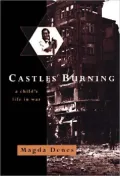
There are few figures in literature as riveting as the precocious nine-year-old Magda Denes who narrates this story. Her stubborn self-command and irrepressible awareness of the absurd make her in her mother's eyes "impossibly sarcastic, bigmouthed, insolent, and far too smart" for her own good. When her family goes into hiding from the fascist Arrow-Cross, she is torn from the "castle" of intimacies shared with her adored and adoring older brother and plunged into a world of incomprehensible deprivation, separation, and loss. Her rage, and her ability to feel devastating sorrow and still to insist on life, will reach every reader at the core. Recounting an odyssey through the wreckage and homelessness of postwar Europe, Castles Burning embodies a powerful personality, a stunning gift for prose and storytelling, a remarkable sense of humor, and true emotional wisdom and makes a magnificent contribution to the literature of childhood and war.Editorials
Publishers Weekly -
This extraordinarily moving Holocaust memoir adds a new dimension to the literature. Denes was five years old in 1939 when her father, a wealthy Hungarian Jewish publisher, left Hungary after his newspaper was seized by the authorities, leaving Magda, her 12-year-old brother, Ivan, and their mother to cope with wartime conditions in Budapest and, ultimately, the German takeover in March 1944. The author recounts with unsentimental candor how she and her family survived years of hiding in Hungry and, later, lived as displaced persons in Germany. Denes endured starvation, the death of her beloved brother and homelessness with a feisty refusal to give way to despair. What sustained her and what makes this recollection remarkable is Denes's ability to recall and express the enormous hostility she felt toward her mother for placing her in homes away from her family, her impatience with her aunt and grandparents, her fury at her father for his desertion and the cynicism beyond her years she used as a defense against an insane world. Photos not seen by PW. Author tour. (Jan.)Library Journal
Denes, a teacher, psychoanalyst, and author, has spent her professional life helping Holocaust survivors deal with their psychological trauma. After 50 years of silence, she tells the story of her own childhood as a fugitive in Budapest, and later a displaced person, in a riveting account of the psychological consequences of the Holocaust. The physical suffering of Holocaust victims endured is already documented; what stands out here is Denes's description of the paranoia and feelings of abandonment that come with long separation from family and friends. Ultimately, for Denes, the long-term psychological consequences of the Holocaust developed out of the destruction of her family, not only through the death of loved ones but through the alienation from those who survived. Recommended for libraries with Judaica collections.-Frederic Krome, Northern Kentucky Univ., Highland HeightsBernard Weiner
Achieves a universality and emotional immediacy that is stunning in its power.—(Bernard Weiner, San Francisco Sunday Examiner and Chronicle)
Lois Blinkhorn
An amazing memoir: funny, touching, frightening—and always readable.—Lois Blinkhorn, Milwaukee Journal Sentinel
Julie Salamon
Redemptive…powerful and surprising…stunning…fascinating and touching.—Julie Salamon, Los Angeles Times
Book Details
Published
August 10, 1999
Publisher
W. W. Norton & Co.
Pages
352
Format
Hardcover
ISBN
9780393039665