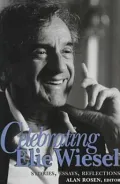
Elie Wiesel
Since his unprecedented memoir Night woke up the world to the atrocities of the Holocaust in 1958, Nobel laureate Elie Wiesel has dedicated his days to turning his survival story from one of horror to one of hope. From several works inspired by his experience to his insightful reflections in After the Darkness, Wiesel’s work serves to both admonish and inspire.
Biography
"Never shall I forget that night, the first night in camp, which has turned my life into one long night, seven times cursed and seven times sealed. Never shall I forget that smoke. Never shall I forget the little faces of the children, whose bodies I saw turned into wreaths of smoke beneath a silent blue sky." Since the publication of this passage in Night, Elie Wiesel has devoted his life to ensuring that the world never forgets the horrors of the Holocaust, and to fostering the hope that they never happen again. Wiesel was 15 years old when the Nazis invaded his hometown of Sighet, Romania. He and his family were taken to Auschwitz, where his mother and the youngest of his three sisters died. He and his father were later transported to Buchenwald, where his father died shortly before Allied forces liberated the camp in 1945. After the war, Wiesel attended the Sorbonne in Paris and worked for a while as a journalist. He met the Nobel Prize-winning writer Francois Mauriac, who helped persuade Wiesel to break his private vow never to speak of his experiences in the death camps.
During a long recuperation from a car accident in New York City in 1956, Wiesel decided to make his home in the United States. His memoir Night, which appeared two years later (compressed from an earlier, longer work, And the World Remained Silent), was initially met with skepticism. "The Holocaust was not something people wanted to know about in those days," Wiesel later said in a Time magazine interview.
But eventually the book drew recognition and readers. "A slim volume of terrifying power" (The New York Times), Night remains one of the most widely read works on the Holocaust. It was followed by over 40 more books, including novels, essay collections and plays. Wiesel's writings often explore the paradoxes raised by his memories: he finds it impossible to speak about the Holocaust, yet impossible to remain silent; impossible to believe in God, yet impossible not to believe.
Wiesel has also worked to bring attention to the plight of oppressed people around the world. "When human lives are endangered, when human dignity is in jeopardy, national borders and sensitivities become irrelevant," he said in his acceptance speech for the Nobel Peace Prize in 1986. "Wherever men and women are persecuted because of their race, religion, or political views, that place must -- at that moment -- become the center of the universe."
Though lauded by many as a crusader for justice, Wiesel has also been criticized for his part in what some see as the commercialization of the Holocaust. In his 2000 memoir And the Sea Is Never Full, Wiesel shares some of his own qualms about fame and politics, but reiterates what he sees as his duty as a survivor and witness:
''The one among us who would survive would testify for all of us. He would speak and demand justice on our behalf; as our spokesman he would make certain that our memory would penetrate that of humanity. He would do nothing else.''
Good To Know
Use of the term "Holocaust" to describe the extermination of six million Jews and millions of other civilians by the Nazis is widely thought to have originated in Night. Two of Wiesel's subsequent works , Dawn and The Accident, form a kind of trilogy with Night. "These stories live deeply in all that I have written and all that I am ever going to write," the author has said.
President Jimmy Carter appointed Wiesel to be chairman of the President's Commission on the Holocaust in 1978. In 1980, Wiesel became founding chairman of the United States Holocaust Memorial Council. He is also the founding president of the Paris-based Universal Academy of Cultures and cofounder of the Elie Wiesel Foundation for Humanity.
Since 1969, Marion Wiesel has translated her husband Elie's books from French into English. They live in New York City and have one son.