
Language, Philosophy of, Education - Philosophy & Social Aspects, 20th Century American Philosophy, Linguistics & Semiotics - General & Miscellaneous, Education, Philosophy of
Available on Bookshop
Write a review
Books.org participates in affiliate programs including Bookshop.org and the Amazon Services LLC Associates Program. We may earn a commission from qualifying purchases made through links on this page, at no additional cost to you.
Log in to track your reading progress.
Overview
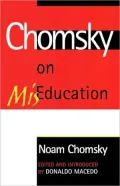
In this book, Chomsky builds a larger understanding of our educational needs, starting with the changing role of schools today, yet broadening our view toward new models of public education for citizenship.
Editorials
The New York Times
Judged in terms of power, range, novelty, and influence of his thought, Noam Chomsky is arguably the most important intellectual alive today.New Statesman
[Chomsky has] a proud defensive independence, a good plain writer's hatred of expert mystification, a doctrine of resistance which runs against the melioristic and participatory current of most contemporary intellectual life. . . . Such men are dangerous; the lack of them is disasterous.Boston Review
Chomsky's intellect continues to be provocative and liberating.Times Higher Education Supplement
Excellent book.Henry A. Giroux
Chomsky and Macedo provide a brilliant analysis of schooling that draws upon a language of critique and possibility that reclaims the notion of schooling as a public good and a democratic force. At a time when teachers, students, and public life in general are under assault by the juggernaut of commodification and capital accumulation, it is crucial that educators, parents, youth, and others be offered a language in which politics, power, justice, and social change become central to any notion of educational reform. Chomsky and Macedo's book fulfills this task with great courage and penetrating wisdom. This is a book that should be read by everyone interested in education and the crisis of democracy.The New York Times
[Chomsky] continues to challenge our assumptions long after other critics have gone to bed. He has become the foremost gadfly of our national conscience.Education Week
The first book to systematically offer all of this prolific writer and public intellectual's influential writings on education.Education Review
Chomsky on MisEducation is a helpful addition to the literature on critical, cultural, and educational analysis.Mind
The collected essays are the work of a critical and independent mind and deserve a wide audience of educators and anyone concerned with the survival of democracy.New Statesman
[Chomsky has] a proud defensive independence, a good plain writer's hatred of expert mystification, a doctrine of resistance which runs against the melioristic and participatory current of most contemporary intellectual life....Such men are dangerous; the lack of them is disasterous.New York Times Book Review
[Chomsky] continues to challenge our assumptions long after other critics have gone to bed. He has become the foremost gadfly of our national conscience.— Christopher Lehmann-Haupt
New York Times Book Review
Judged in terms of power, range, novelty and influence of his thought, Noam Chomsky is arguably the most important intellectual alive today.From The Critics
In a time when educational reform is on every politician's empathetic lips, we, as a nation, seem united by the idea that our schools are in need of drastic change. Of course, the changes that are inevitably brought up have to do with concrete issues—class size, teachers' salaries, metal detectors and school funding. Never mentioned, except by the occasional home-schooling advocate, is the possibility that the educational system itself is flawed; we are teaching our students the wrong things. That's the bracing premise floated in the newest collection of essays and lectures by the anti-authoritarian iconoclast, Noam Chomsky. At the outset, Chomsky states his thesis "Schools have always, throughout history, played an institutional role in a system of control and coercion." Chomsky has always been a stubborn force for the American left, attacking the remotest hints of totalitarianism, regardless of which way the winds are blowing, and he would have been the perfect pin to pop the hot-air bubble that is the current educational debate. Unfortunately, Macedo, the book's editor, has chosen pieces on Chomsky's usual themes: the spreading of misinformation, manufacturing of consensus, the illusion of the free market. There is hardly anything here specifically addressing educational reform, which is a shame, as Chomsky would have brought a unique perspective to it as an MIT professor. This book portrays Chomsky at his best—bitingly sarcastic, relentlessly logical and passionate—but it's just not the book that the title promises.—Chris Barsanti
Library Journal
Although the title of Chomsky's latest work implies a discussion on the "miseducation" of America's students, there is little about education here. The bulk of this book--which includes a lecture delivered at Loyola University in 1994, a chapter reprinted from a 1989 work by Chomsky, and a lecture delivered at the University of Cape Town, South Africa, in 1997--rehashes his assertions that U.S. government policies are tied to the interests of the corporate elite. Chomsky, a political dissident as well as a noted linguist, focuses his criticism primarily on America's foreign policies in Central America, claiming that we have condemned the actions of certain factions while condoning similar actions of other factions and have hidden many such things from the American public. The lone exception to this theme is the first chapter, a dialog between Chomsky and Donaldo Macedo, where Chomsky argues that American schools discourage independent thinking and are more interested in controlling students and catering to the wishes of those who have wealth and power. But even here, Chomsky quickly goes off the mark and steers the discussion to American foreign policy. Considering that most of the material is not original and is dated, this is a marginal purchase even for academic libraries.--Terry Christner, Hutchinson P.L., KS Copyright 2000 Cahners Business Information.Booknews
Contains the edited text of five essays, lectures, interviews, and a debate in which Chomsky participated, on the subject of education. Addresses the changing role of schools, new models of public education for citizenship, the role of global technological change, the media's involvement in educational ideology, and the democratic role of schools and higher education. Annotation c. Book News, Inc., Portland, OR (booknews.com)Book Details
Published
April 1, 2004
Publisher
Rowman & Littlefield
Pages
208
Format
Paperback
ISBN
9780742529786