
United States - Colonial & 18th Century - History
Log in to track your reading progress.
Editorials
Children's Literature
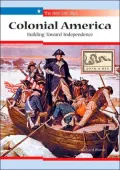
The early history of the thirteen colonies that became the foundation of the United States, called the colonial period, is the subject of this title in the "American Saga" series. It documents the culture, customs, and major events that preceded the establishment of the republic in 1776. The era was filled with turmoil and fluid alliances as the early settlements coalesced into well-defined towns and states with clearly structured governments. Many factors influenced the developing culture, customs, trade, religions and legal systems of the nation as it formed. These factors are discussed in eight chapters liberally illustrated with photographs, drawings, graphics and maps. Side bars offer supplemental text and details. At the end of the book, a time line, chapter notes, glossary, further reading, internet addresses, and an index offer suggestions for additional research. This is a well-executed summary of early American history and would be a good addition to any classroom or school library containing resources on colonial America. 2006, Enslow Publishers, Ages 12 up.—Hazel Buys
School Library Journal
Gr 5-8-Worth opens with a chapter on the Declaration of Independence and then turns back to the 1500s and 1600s to discuss English settlements. The narrative ends with commentary on the ratification of the Constitution. The author acknowledges the presence of the Spanish in America prior to the English but does not discuss Native peoples before the 1600s. He also explores how fighting wars with Spain and France both depleted Great Britain's finances and gave the American colonists valuable experience that they would later use against the British. Although the author identifies and describes a variety of Native groups, information about these peoples is presented primarily in terms of how their presence affected the Europeans. Politics and government are covered most extensively, although economic matters and domestic culture are also included, as in the discussion of the economic and social impact of slavery. The utilitarian text is enlivened by color maps, photographs, reproductions, drawings, pull quotes, and sidebars that highlight significant individuals. Chapter notes provide sources. This material is likely to be useful to report writers.-Lucinda Snyder Whitehurst, St. Christopher's School, Richmond, VA Copyright 2006 Reed Business Information.Book Details
Published
May 1, 2006
Publisher
Enslow Publishers, Incorporated
Pages
128
Format
Library Binding
ISBN
9780766025691