
History of Communism, 1991 - Present (Post-Soviet Russia) - History, Social, Cultural & Economic Aspects of Communism, Soviet History - Political Aspects, Russia (Federation) - History - Political Aspects, World History - General & Miscellaneous, Russia &
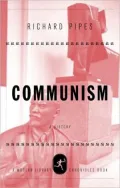
Available on Bookshop
Write a review
Books.org participates in affiliate programs including Bookshop.org and the Amazon Services LLC Associates Program. We may earn a commission from qualifying purchases made through links on this page, at no additional cost to you.
Log in to track your reading progress.
Overview
From one of our greatest historians, a magnificent reckoning with the modern world's most fateful idea.With astonishing authority and clarity, Richard Pipes has fused a lifetime's scholarship into a single focused history of Communism, from its hopeful birth as a theory to its miserable death as a practice.
At its heart, the book is a history of the Soviet Union, the most comprehensive reorganization of human society ever attempted by a nation-state. Drawing on much new information, Richard Pipes explains the countryís evolution from the 1917 revolution to the Great Terror and World War II, global expansion and the Cold War chess match with the United States, and the regime's decline and ultimate collapse. There is no more dramatic story in modern history, nor one more crucial to master, than that of how the writing and agitation of two mid-nineteenth-century European thinkers named Marx and Engels led to a great and terrible world religion that brought down a mighty empire, consumed the world in conflict, and left in its wake a devastation whose full costs can only now be tabulated.
From the Hardcover edition.
Editorials
Publishers Weekly
This opinionated introduction to communism would be better subtitled "requiem for a misguided ideology." Pipes (The Russian Revolution) focuses much of the book on his own field of specialty the rise and fall of the Soviet Union. The Harvard historian is at his best here, providing a thorough account of the ascendancy of the Russian party in the late 19th and early 20th centuries in accessible and at times eloquent prose: "Soviet totalitarianism thus grew out of Marxist seeds planted on the soil of tsarist patrimonialism." Part of the Modern Library's series on world history, the book details Soviet atrocities, emphasizing how Communist agricultural policies not only suppressed human rights but led to famines that killed millions of Soviet citizens. The sections on communism in other countries are much shorter and not as strong, particularly the discussion of Chile, in which Pipes fails to address the involvement of the United States in the 1973 coup that overthrew Socialist leader Salvador Allende. Throughout this volume, Pipes, a longtime Cold Warrior who served as Reagan's National Security Council adviser on Soviet and East European affairs, is on a mission to prove that communism's egalitarian impulses run contrary to human nature. Whether or not they agree with Pipes's views, students and general readers alike will benefit from this concise, insightful work. (Sept.) Forecast: The book is certain to be widely taught in its field and will be promoted in a brochure mailing to historians but a three-city author tour and series advertising in the New York Times Book Review, the Chronicle of Higher Education and Lingua Franca should help the book find a more general though learnedreadership as well. Copyright 2001 Cahners Business Information.Library Journal
Pipes brings to this short study unsurpassed credentials as a historian of 19th- and 20th-century Russia. His Russia Under the Old Regime (LJ 3/15/75. o.p.) offered, at much greater length than here, his views on the Bolshevik Revolution and the ensuing course of Soviet history. For him it is a tale of unremitting failure and tragedy, even more apocalyptic than that told in Martin Malia's The Soviet Tragedy (1994). Here he sketches out a background to the idea of communism, then outlines its application in Russia by Lenin, Stalin, and their heirs and its reception in the West and the Third World. Pipes is relentless. Communist leaders are ruthless or psychotic killers (in Pol Pot's case, fair enough), starry-eyed idealists, or corrupt and cynical party hacks. Castro is little better than a pimp for Cuban women. A final section, "Looking Back," emphasizes the human and psychological cost to Russia and the world of this illusion. As a brief, polemical diatribe by one of its fiercest Western critics and historians, this short account of communism should provoke and instruct. For general and academic libraries. Robert Johnston, McMaster Univ., Hamilton, Ont. Copyright 2001 Cahners Business Information.Booknews
Pipes, a celebrated historian of Russia (he's now emeritus at Harvard U.), offers a lucid and compelling analysis of the theory, development, history, and inherent problems with Communism. The strength of the book comes from the author's detailed knowledge of Russian history which has been mined for a constant flow of specific proofs to enrich the arguments. Annotation c. Book News, Inc., Portland, OR (booknews.com)Kirkus Reviews
An erudite yet readable introduction to the economic theory that grew into the 20th century's worst political nightmare, by distinguished historian Pipes (Prosperity and Freedom, 1999, etc.). In a masterfully succinct survey, Pipes provides a good glimpse of many of the precursors of communism (Plato's Republic, More's Utopia, etc.), but he rightly concentrates on the 19th century and the enigmatic figure of Karl Marx as the true founder of the creed. Marx promulgated two basic ideas that were essential to the development of communism: 1) there is an inexorable natural law that governs the course of human history; and 2) all wealth is created by labor. The first proposition was beyond proof, of course, and the second was dubious at best, but these were the first of many miscalculations that Marx's followers had to overlook in the decades that followed. For, as the author allows, "Marxism in its pure, unadulterated form was nowhere adopted as a political platform because it flew in the face of reality." It developed instead into social democracy (in Western Europe) and communism (in Eastern Europe)-the main distinction between the two being the comparative emphasis that was placed on violence and terror as a means of redressing social injustice. The tragic history of Soviet Communism is recounted at length, and Pipes is at pains to demonstrate that, just as Stalinist terror was not (despite Trotskyist objections) an abuse of Leninist principles, Lenin's own vicious pragmatism and astounding cruelty were perfectly in line with Marx's approach to politics. The pathetic corruption of the Soviet apparat (with its privileged caste of Party members who lived in a hermetic society ofprivate stores, housing, schools, hospitals, etc.) was not, in the author's view, a later malformation-it was, in fact, present almost from the very first days of the Bolshevist coup and was very largely responsible for its success. As one sociologist comments sadly, "socialist may triumph, but socialism never." Superbly informative, written with great insight and real style.From the Publisher
“In the name of great good, Communism has brought great evil. . . . If you’ve wondered how your children and grandchildren are going to grasp this large and alien reality, a good move is to make sure they own this book.” —The Weekly Standard“The publication of Richard Pipes’ Communism: A History . . . is of signal importance. One cannot put it down without realizing, once and for all, that the road to utopia is paved with the bodies of the innocent—and leads nowhere.” —Baltimore Sun
“I wish every university student . . . would read this grim book.” —Paul Johnson
Book Details
Published
November 6, 2001
Publisher
Random House Publishing Group
ISBN
9781588360960