
Transportation - General & Miscellaneous, United States - History - General & Miscellaneous
Log in to track your reading progress.
Synopsis
Explains how Conestoga wagons were built and driven as well as their historical significance and importance to the early American economy.
Parent Council Reviews
Books such as "Conestoga Wagons" can teach more history than a textbook. The fine illustrations highlight Pennsylvania's past during the era that the Conestoga wagons were built. Did you know they were used as freight wagons in the eastern United States prior to the push westward? 2000, Holiday House, Inc., $16.95. Ages 8 to 12. Reviewer: A. Braga SOURCE: Parent Council Volume 8
Editorials
From The Critics
Books such as "Conestoga Wagons" can teach more history than a textbook. The fine illustrations highlight Pennsylvania's past during the era that the Conestoga wagons were built. Did you know they were used as freight wagons in the eastern United States prior to the push westward? 2000, Holiday House, Inc., $16.95. Ages 8 to 12. Reviewer: A. Braga SOURCE: Parent Council Volume 8Children's Literature
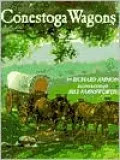
Farnsworth's beautiful illustrations set the scene for this informative book that successfully transports readers back to the era between 1750 and 1850 when Conestoga wagons served as the tractor-trailer trucks of the time. The focus is in Pennsylvania, especially the route between Philadelphia and Lancaster. Detailed diagrams and careful labeling provide visual clarity for students who want to know exactly how these wagons worked. The fact-filled text is sometimes strained, probably due to Ammon's desire to include as much information as possible. Students with an interest in this subject or the need to write a report will appreciate the effort and most likely will not notice nor care about the occasional awkwardness of the text. 2000, Holiday House, Ages 6 to 10, $16.95. Reviewer: Phyllis KennemerSchool Library Journal
Gr 2-5-This informational picture book is a unique celebration of a mode of transportation that served early America well. Built in Lancaster County, PA, between 1750 and 1850, Conestogas were a better class of covered wagon, being sturdily built in three different sizes and having brakes. Ammon explains how these "tractor-trailer trucks" of their time played an important role in both the Revolutionary War and the War of 1812. Loaded with interesting facts on travel in the early days of westward expansion and comparisons to modern-day life, this fascinating title captures readers' imaginations. The massive, now extinct Conestoga horses used to pull the wagons are deftly described. Several unfamiliar terms, such as "lazy board" and "jerk line" are explained in the text. The full- and double-paged, soft-toned impressionistic paintings are supplemented by smaller monochrome sketches. This accessible tribute to an American icon will enrich any unit on pioneer times.-Anne Chapman Callaghan, Racine Public Library, WI Copyright 2000 Cahners Business Information.|Kirkus Reviews
In a tribute to "the tractortrailers of their time," the author describes in loving detail the history and value of the uniquely designed Conestoga wagon. From 1750 to 1850, the Conestoga was king, and sometimes as many as 3,000 wagons a day traveled between Philadelphia and Lancaster as well as west to Harrisburg and Pittsburgh. They carried as much as five tons of cargo: loads of bacon, butter, cider, flour, rope, tools, mail, coal, and more from port cities to settlements throughout Pennsylvania along what would become the Pennsylvania Turnpike. Ammon (An Amish Year, 1999, etc.) explains in detail how the wagon was built by hand, including shaping the wooden body, waterproofing the linen cover with linseed oil or beeswax, forging the iron rim to the wooden wheel of 14 or 16 spokes, attaching the end gate, and setting the hitch for easy hauling of heavy loads. Readers will learn how advanced this wagon was; for instance, it was the only one to have brakes. Several contemporary expressions derive from those wagon days: "Mind your P's and Q's," "I'll be there with bells on," and "teamster." While the text is rich in detail, the paintings by the illustrator of Robert Fulton: From Submarine to Steamboat (1999) provide a dreamy contrast. In muted sepia and gold, or muted blues and grays, they hint of times past, but occasionally miss some of the clear details the viewer longs for, given the superbly precise text. Still this is a strikingly welldone essay on a slice of Americana seldom told and well worth exploring. (Nonfiction. 911)Book Details
Published
September 1, 2000
Publisher
Holiday House, Inc.
Pages
32
Format
Hardcover
ISBN
9780823414758