
General & Miscellaneous Law, Logic, Philosophical Methodology, Professional Responsibility & Legal Ethics, Ethics & Moral Philosophy - Theoretical, Constitutional Law - General & Miscellaneous, Legal Methodology & Language
Available on Bookshop
Write a review
Books.org participates in affiliate programs including Bookshop.org and the Amazon Services LLC Associates Program. We may earn a commission from qualifying purchases made through links on this page, at no additional cost to you.
Log in to track your reading progress.
Overview
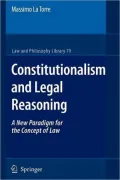
This book of legal philosophy contends that positive law is better understood if it is not too easily equated with power, force, or command. Law is more a matter of discourse and deliberation than of sheer decision or of power relations. Here is thought-provoking reading for lawyers, advocates, scholars of jurisprudence, students of law, philosophy and political science, and general readers concerned with the future of the constitutional state.
Synopsis
This book, which consist of three chapters and two appendices, is intended to connect subjects that have usually been considered as detached or not strongly connected: constitutionalism, legal argumen- tion and legal ethics. Its main contention is that contemporary consti- tionalism pushes towards a new style of legal reasoning, which needs to take into account moral criteria and principles and that eventually the interpretative and moralist approach will lead to a somewhat unort- dox and less authoritarian concept of law. A constitution to be taken seriously and as a distinct and superior source of law, will end up referring to some sort of constitutional justice or judicial review. And constitutional reasoning and justice need to make recourse to principles but principles to be given an operative content should be elaborated through some form of moral reasoning. This r- soning however, if it does not want to betray the spirit of constitutional democracy and the very idea of a constitution as a special moment of self-determination, could not be just Platonism, a cognitivism without roots in the practice of public discourse and deliberation. So that cons- tutionalism will not really do without a public sphere and some activism of the latter. But if this is so, the traditional concept of law based on hi- archy, commands, prescription, sanction, and in the last instance violence, becomes obsolete. A law which is a command cannot be congruent with a practice ruled by discourse, that is, I argue, with constitution.Book Details
Published
November 23, 2010
Publisher
Springer-Verlag New York, LLC
Pages
206
Format
Paperback
ISBN
9789048174041