
Post-Communism, European Studies - Eastern Europe, Poland - History, National Characteristics - Europe, Eastern Europe - Politics & Government
Log in to track your reading progress.
Overview
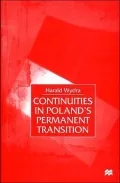
This book examines change in post-1989 Poland by linking it analytically to the continuity of Poland's past. It argues that the first reality of objective-institutional changes is underpinned by the continuity of second realities. Political crises and conflicts are analyzed as to the impact of images on identities in situations of dissolution of order. Based on an interdisciplinary analysis of the Polish case, this study proposes a new conceptual framework for the study of transitional societies and revises standard assumptions in transitology and democratization studies.Synopsis
This book examines change in post-1989 Poland by linking it analytically to the continuity of Poland's past. It argues that the first reality of objective-institutional changes is underpinned by the continuity of second realities. Political crises and conflicts are analyzed as to the impact of images on identities in situations of dissolution of order. Based on an interdisciplinary analysis of the Polish case, this study proposes a new conceptual framework for the study of transitional societies and revises standard assumptions in transitology and democratization studies.This book examines change in post-1989 Poland by linking it analytically to the continuity of Poland's past. It argues that the first reality of objective-institutional changes is underpinned by the continuity of second realities. Political crises and conflicts are analyzed as to the impact of images on identities in situations of dissolution of order. Based on an interdisciplinary analysis of the Polish case, this study proposes a new conceptual framework for the study of transitional societies and revises standard assumptions in transitology and democratization studies.Editorials
Booknews
Sydra (political science, U. of Regensburg) claims that 1989 was not the rupture point in Polish politics that studies in transition and democratization make it out to be. He examines the causes the lengthy transition to western models of political and societal organization using two tracks of analysis. He concludes that both before and after 1989, politics has been at a permanent threshold where political elites have recurrently found themselves between a dissolution of order and political utopias. Annotation c. Book News, Inc., Portland, OR (booknews.com)Book Details
Published
November 1, 2000
Publisher
Palgrave MacMillan
Pages
271
Format
Hardcover
ISBN
9780312231354