
United States History - 20th Century - General & Miscellaneous, Korean History, Diplomatic Relations, Military Policy, Asia - Politics & Government, World Politics, Diplomacy & International Relations, General & Miscellaneous World History, U.S. Internati
Log in to track your reading progress.
Overview
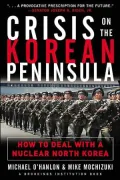
In Crisis on the Korean Peninsula, foreign policy scholars and opinion leaders Michael O'Hanlon and Mike Mochizuki introduce a broad and ambitious program designed to answer - once and for all - the stubborn North Korean question. Detailing a "grand bargain" by which the United States and its allies could defuse North Korea's military threat without resorting to Iraq-style war, this examination outlines a step-by-step process that would: address the nuclear weapons issue that so clouds North Korea's present and future global status and northeast Asia's security; reduce conventional military forces, begin to rebuild the nation's shattered economy, and solve its ongoing humanitarian crisis; and provide face-saving and nerve-calming security assurances to North Korea's embattled leaders, who show signs they might welcome such pledges.Editorials
The Washington Post
Michael O'Hanlon holds a chair at the Brookings Institution, as does Mike Mochizuki at George Washington University. O'Hanlon's expertise on arms control and military technology merges nicely with Mochizuki's knowledge of East Asian security affairs, and as a result their book is smart, dispassionate and full of new information. They balance their criticism of Bush with a retrospective critique of Bill Clinton's diplomacy toward Pyongyang, and try to split the difference between "liberals and realists" with a "grand bargain" that rests equally on toughness and inducements. — Bruce CumingsPublishers Weekly
The authors of this study have a worthy goal: to completely transform the nature of the world's relationship with North Korea. Although appreciative of previous attempts to freeze the North's provocative nuclear program, O'Hanlon and Mochizuki see the faults in past efforts, and make a strong case for a new way to bring a stable peace to the peninsula and to introduce the so-called Hermit Kingdom to the international community. Few are more qualified to address the issue than "[t]he two Mikes," as they are dubbed in the foreword by Brookings Institution president Strobe Talbott. The pair have passed their careers in many of the nation's best think tanks and universities, and have spent much ink on the topic of East Asian security. In this instance, they propose a clear, reasoned and, most important, achievable "grand bargain" with the North that would involve a broad range of demands while offering specific incentives to reform. To readers unfamiliar with the nuclear crisis that has unfolded since October of last year, when North Korea allegedly admitted it possessed a uranium-enrichment program, the book can be unforgiving; O'Hanlon and Mochizuki launch right into their nuanced approach to defuse the crisis. After they outline their proposal, however, the book becomes a comprehensive, must-read introductory text to the conflict, and the subject is bizarre enough to hold anyone's attention, or at least anyone who thinks a leader said to have been born amid the appearance of double rainbows and able to write up to 1,000 books a day is bizarre. (Sept. 5) Copyright 2003 Reed Business Information.Foreign Affairs
At a time of growing awareness of the threat that North Korea's nuclear capacity represents, O'Hanlon and Mochizuki offer a provocative "Grand Bargain" to solve the problem. They propose that "the five" — Washington, Tokyo, Seoul, Beijing, and Moscow — give North Korea $2 billion a year in economic aid in exchange for Pyongyang's abandoning all nuclear activities and allowing full inspections. This deal would be accompanied by reductions in conventional forces in North and South Korea and in U.S. troops stationed in East Asia — all of which would hasten Korean reunification. Theirs is a bold vision, supported by detailed knowledge of North Korea and rigorous analysis of technical challenges. Events, however, may be starting to overtake them. The Bush administration's multilateral approach has attracted Pyongyang's interest, and Beijing has welcomed the possibility of playing a greater role. Still, the book has great value as a model for analyzing problems of nuclear proliferation and for understanding North Korea.Library Journal
In October 2002, the North Korean government startled the world by announcing that it possessed nuclear weapons and by withdrawing from the 1970 Nonproliferation Treaty. This new work by two scholars associated with the Brookings Institution provides helpful background on the country and the current dilemma it poses for world leaders. The authors propose a "roadmap" approach to resolving the issues: beginning with the 1994 Agreed Framework (which denuclearized North Korea), North Korea would be required to dismantle its nuclear capability immediately, then reduce its conventional forces, and then improve its human rights record. Each step would bring a benefit from the United States, e.g., immediate resumption of fuel oil shipments for the power plants. Though other think tanks have recently issued policy recommendations on this topic, this report is the most detailed and concrete to date. Unfortunately, issues of nuclear weapons and rogue states have always proven to be intractable, and those with short attention spans lose interest quickly. For this reason, this comprehensive report will appeal primarily to policy wonks. For academic libraries.-Marcia L. Sprules, Council on Foreign Relations Lib., New York Copyright 2003 Reed Business Information.Book Details
Published
August 1, 2003
Publisher
New York ; McGraw-Hill, c2003.
Pages
172
Format
Hardcover
ISBN
9780071431552