
Computer Security, Computer Science & Combinatorics, General Software Engineering, Cryptography
Log in to track your reading progress.
Overview
Learn to Use the Right Cryptography Library Everytime!No longer is it an option for software to include cryptography; everyone from office suites to accounting software and eCommerce Web sites use it. So today’s developers have to know how to write software that includes cryptographic functionality. Although they are usually familiar with the basics of cryptography, they are not always familiar enough with the available products to select the right API/library and get up and running with it quickly.
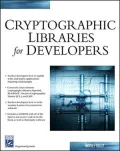
Cryptographic Libraries for Developers teaches developers about the available APIs and helps them select the right ones for their projects based on platform, language, and regulatory requirements. The book serves as a nuts and bolts guide to writing software using these libraries and provides abundant examples and detailed examples throughout. The libraries covered include OpenSSL, B/Safe, the Java Cryptographic Library (JCE,) as sign/verify, encrypt/decrypt (asymmetric and symmetric,) MACs, and Hashing, as well as higher-level primitives such as X.509 digital certificates and secure (SSL) communications. Key Features:Provides a practical guide that teaches developers how to rapidly write and del=ploy applications requiring cryptography
Covers the five common cryptography libraries: OpenSSL, B/Safe, the Java Cryptographic Library (JCE), and CAPI
Teaches developers how to write security features for commercial software
Includes a CD-ROM with all of the features and source code from the book On the CD!
Code Snippets: The snippets of examples source code used throughout this book are included on this CD-ROM within their broader context
Example Applications: Example frameworks and applications developed using the techniques, libraries, and strategies described within this book. Included as well are any and all design diagrams used in the preparation of the examples System Requirements
Windows: Microsoft Windows NT 4.0 Sp6, Microsoft Windows XP Professional or Home, of 2003 Server, 256MB RAM, 20MB fixed storage (required for compilation of samples), a compiler and/or development environment corresponding to the samples you wish to utilize. For example, Microsoft Visual Studio, Visual C++, Sun’s Java 2 Platform Standard Edition (i.e., the JDK), etc. UNIX: A POSIX-compliant operating system such as Solaris, Linux, BSD, HPUX, True-64, AIX, etc.; 10MB fixed storage (repaired for compilation of samples, a compiler and/or development environment corresponding to the samples you wish to utilize. For example, gcc/g++, Sun’s Java 2 Platform Standard Edition (i.e., the JDK), etc. OPTIONAL: To compile C/C++ software, the "make" utility greatly increases the efficiency of the compilation process.
Book Details
Published
January 14, 2006
Publisher
Charles River Media
Pages
464
Format
Paperback
ISBN
9781584504092