
Earth Science, Chemistry - General and miscellaneous, Biology & Life Sciences, Analytical Chemistry, Biochemistry, Earth Science, Biology, Chemistry - Biochemistry
Log in to track your reading progress.
Overview
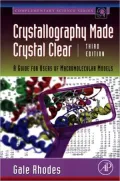
Crystallography Made Crystal Clear makes crystallography accessible to readers who have no prior knowledge of the field or its mathematical basis. This is the most comprehensive and concise reference for beginning Macromolecular crystallographers, written by a leading expert in the field. Rhodes' uses visual and geometric models to help readers understand the mathematics that form the basis of x-ray crystallography. He has invested a great deal of time and effort on World Wide Web tools for users of models, including beginning-level tutorials in molecular modeling on personal computers. Rhodes' personal CMCC Home Page also provides access to tools and links to resources discussed in the text. Most significantly, the final chapter introduces the reader to macromolecular modeling on personal computers-featuring SwissPdbViewer, a free, powerful modeling program now available for PC, Power Macintosh, and Unix computers. This updated and expanded new edition uses attractive four-color art, web tool access for further study, and concise language to explain the basis of X-ray crystallography, increasingly vital in today's research labs.* Helps readers to understand where models come from, so they don't use them blindly and
inappropriately
* Provides many visual and geometric models for understanding a largely mathematical method
* Allows readers to judge whether recently published models are of sufficiently high quality and detail to be useful in their own work
* Allows readers to study macromolecular structure independently and in an open-ended fashion on their own computers, without being limited to textbook or journals illustrations
* Provides access to web tools in a format that will not go out of date. Links will be updated and added as existing resources change location or are added
Audience: Biophysicists, biochemists, molecular biologists, and structural chemists.
Synopsis
Crystallography Made Crystal Clear makes crystallography accessible to readers who have no prior knowledge of the field or its mathematical basis. This is the most comprehensive and concise reference for beginning Macromolecular crystallographers, written by a leading expert in the field. Rhodes' uses visual and geometric models to help readers understand the mathematics that form the basis of x-ray crystallography. He has invested a great deal of time and effort on World Wide Web tools for users of models, including beginning-level tutorials in molecular modeling on personal computers. Rhodes' personal CMCC Home Page also provides access to tools and links to resources discussed in the text. Most significantly, the final chapter introduces the reader to macromolecular modeling on personal computers-featuring SwissPdbViewer, a free, powerful modeling program now available for PC, Power Macintosh, and Unix computers. This updated and expanded new edition uses attractive four-color art, web tool access for further study, and concise language to explain the basis of X-ray crystallography, increasingly vital in today's research labs.* Helps readers to understand where models come from, so they don't use them blindly and
inappropriately
* Provides many visual and geometric models for understanding a largely mathematical method
* Allows readers to judge whether recently published models are of sufficiently high quality and detail to be useful in their own work
* Allows readers to study macromolecular structure independently and in an open-ended fashion on their own computers, without being limited to textbook or journals illustrations
* Provides access to web tools in a format that will not go out of date. Links will be updated and added as existing resources change location or are added
Editorials
Eugene A. Davidson
The first volume of this work was a useful addition to the field of crystallography, and this second edition is a worthy successor. "The intent is to provide a basic introduction to x-ray crystallography of proteins. "The author of this volume provides students and researchers with a general interest a convenient pathway to understanding the technology and how it is applied. "He offers up-to-date, ancillary information on X-ray sources (synchrotron radiation) and NMR, the only other method for obtaining tertiary structural information. In an introductory chapter he provides an overview of x-ray analysis and follows this with a discussion of crystallization techniques, data acquisition, the phase problem, and modeling. Brief discussions of other structural methods are also of value. "The crystallographic structure of myoglobin and hemoglobin provides an enormous impetus to this strategy since only this x-ray approach offers a close three-dimensional look at proteins. Much of the methodology involved has remained difficult to assimilate, largely because of the intense mathematical requirements and complex data gathering involved. Scientists wishing to understand x-ray methods without having to tackle the mathematics will be well rewarded by reading this volume.Booknews
Describes the logical threads that connect diffraction patterns to the molecular models displayed on personal computers. Focusing on proteins, Rhodes (chemistry, University of Southern Maine) overviews how researchers use the technique of X-ray crystallography to learn macromolecular structures. The second edition adds two chapters on other diffraction methods, and other types of models. Annotation c. Book News, Inc., Portland, OR (booknews.com)From The Critics
Reviewer: Eugene A Davidson, PhD(Georgetown University School of Medicine)Description: The first volume of this work was a useful addition to the field of crystallography, and this second edition is a worthy successor.
Purpose: The intent is to provide a basic introduction to x-ray crystallography of proteins.
Audience: The author of this volume provides students and researchers with a general interest a convenient pathway to understanding the technology and how it is applied.
Features: He offers up-to-date, ancillary information on X-ray sources (synchrotron radiation) and NMR, the only other method for obtaining tertiary structural information. In an introductory chapter he provides an overview of x-ray analysis and follows this with a discussion of crystallization techniques, data acquisition, the phase problem, and modeling. Brief discussions of other structural methods are also of value.
Assessment: The crystallographic structure of myoglobin and hemoglobin provides an enormous impetus to this strategy since only this x-ray approach offers a close three-dimensional look at proteins. Much of the methodology involved has remained difficult to assimilate, largely because of the intense mathematical requirements and complex data gathering involved. Scientists wishing to understand x-ray methods without having to tackle the mathematics will be well rewarded by reading this volume.
From the Publisher
Praise for the first edition"Well-written...in my opinion is now the best reference for noncrystallographers who want to know more about X-ray diffraction and the data that result from it."
-AMERICAN JOURNAL OF PHYSIOLOGY
3 Stars from Doody
Book Details
Published
August 4, 2010
Publisher
Elsevier Science
Pages
352
ISBN
9780080455549