
Psychology & Psychotherapy, Psychology - Theory, History & Research, Socio-Cultural Anthropology, Social Problems
Log in to track your reading progress.
Overview
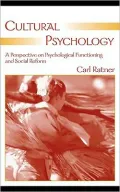
Carl Ratner's new book deepens our understanding of psychology by emphasizing the role that cultural factors, such as social institutions, artifacts, and cultural concepts play in psychological functioning. The author demonstrates the impact of culture on stimulating and structuring emotion, personality, perception, cognition, memory, sexuality, and mental illness. Examples from interdisciplinary social science research illuminate a sophisticated dialectical relationship between cultural factors and psychological phenomena.Written in an engaging style, the book articulates a new theory, "macro cultural psychology", and a qualitative methodology for investigating the cultural origins, characteristics, and functions of psychological phenomena. Ratner explains how this cultural perspective can be used to enhance psychological growth, illuminate directions for social reform, and how social reform can enhance psychological functioning, and vice versa.
Cultural Psychology critically examines several prominent psychological approaches including social constructionism, feminism, hermeneutics, psychobiology, evolutionary, cross-cultural, ecological, and mainstream psychology. The book articulates a theory of macro culture that emphasizes the political dimension of culture and psychology.
Intended for students, researchers, and practitioners in psychology, education, psychotherapy, history, sociology, anthropology, linguistics, philosophy, and policy makers and practitioners in public health and social service who are interested in understanding cultural aspects of psychology. The book is an appropriate text for courses in cross-cultural or community psychology, social work, social theory, and critical thinking.
Editorials
Reviewer: Gary B Kaniuk, Psy.D.(Cermak Health Services)
Description: This book describes cultural psychology, which is looking at behavioral, thought, and emotional patterns from a social rather than an individual perspective. The first part of the book is theoretical and the second provides applications for research, interviewing, identifying psychological themes in narratives, and applications in children's moral reasoning.
Purpose: The author's purpose is twofold: "to articulate a specific and comprehensive conception of culture" (Part I) and "to develop methodological procedures for testing the theoretical issues raised in Part I." In general, the book "seeks to deepen our understanding of the cultural aspects of human psychology." These are worthy objectives. I think the author did achieve these objectives but the book is difficult to read in places.
Audience: The author does not say for whom the book is written, but I think it is written for practitioners and theoreticians. The author seems to be a credible authority.
Features: "The book expands on the notion of activity theory first introduced by Vygotsky and other Russian researchers. The author's goal is to elucidate both theory and methodology of cultural psychology. He applies his theory to research, interviewing, identifying psychological themes in narratives, and children's moral reasoning. The book explains theory well. The only shortcoming is that it is not easy to read in places.
Assessment: This book is very good but I found myself having to read certain passages over and over again. Sometimes it's easy to get mired in theory and not be able to see the bigger picture. However, the author seems to present the methodology section in a more readable manner. I particularly liked the chapter on interviewing techniques.
Book Details
Published
November 17, 2006
Publisher
Taylor & Francis, Inc.
Pages
280
Format
Paperback
ISBN
9781410617316