
Education - History, Education - Social & Political Aspects, Major Branches of Philosophical Study, American Philosophy
Log in to track your reading progress.
Overview
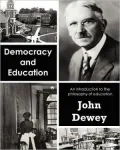
John Dewey's Democracy and Education addresses the challenge of providing quality public education in a democratic society. In this classic work Dewey calls for the complete renewal of public education, arguing for the fusion of vocational and contemplative studies in education and for the necessity of universal education for the advancement of self and society. First published in 1916, Democracy and Education is regarded as the seminal work on public education by one of the most important scholars of the century.Synopsis
John Dewey (1859-1952), writer of Democracy and Education, was an American philosopher, psychologist, and educational reformer whose ideas have been very influential to education and social reform. John Dewey, along with Charles Sanders Peirce and William James, is recognized as one of the founders of the philosophy of pragmatism and of functional psychology. He was a major representative of the progressive and progressive populist philosophies of schooling during the first half of the 20th century in the USA. Although John Dewey is known best for his publications such as Democracy and Education, he also wrote about many other topics, including Experience and Nature, Art and Experience, Logic and Inquiry, Democracy, and Ethics. In his advocacy of democracy, John Dewey considered two fundamental elements-schools and civil society-as being major topics needing attention and reconstruction to encourage experimental intelligence and plurality. John Dewey asserted that complete democracy was to be obtained not just by extending voting rights but also by ensuring that there exists a fully-formed public opinion, accomplished by effective communication among citizens, experts, and politicians, with the latter being accountable for the policies they adopt.John Dewey's most significant writings were "The Reflex Arc Concept in Psychology" (1896), a critique of a standard psychological concept and the basis of all his further work; Democracy and Education (1916), his celebrated work on progressive education; Human Nature and Conduct (1922), a study of the function of habit in human behavior; The Public and its Problems (1927), a defense of democracy written in response to Walter Lippmann's The Phantom Public (1925); Experience and Nature (1925), John Dewey's most "metaphysical" statement; Art as Experience (1934), John Dewey's major work on aesthetics; A Common Faith (1934), a humanistic study of religion originally delivered as the Dwight H. Terry Lectureship at Yale; Logic: The Theory of Inquiry (1938), a statement of John Dewey's unusual conception of logic; Freedom and Culture (1939), a political work examining the roots of fascism; and Knowing and the Known (1949), a book written in conjunction with Arthur F. Bentley that systematically outlines the concept of trans-action, which is central to his other works. While each of these works focuses on one particular philosophical theme, John Dewey included his major themes in most of what he published. John Dewey published more than 700 articles in 140 journals, and approximately 40 books.His main interests were: Philosophy of education, Epistemology, Journalism, and Ethics.*Wiki ReferencesBook Details
Published
April 7, 2012
Publisher
CreateSpace
Pages
154
Format
Paperback
ISBN
9781475158175