
Depression & Mood Disorders, Mood & Affective Disorders, Mental/Psychological Disorder Patients - Biography, Schizophrenia & Other Psychotic Disorders
Log in to track your reading progress.
Overview
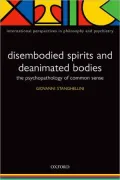
How can we better understand and treat people affected by schizophrenia and manic-depressive illnesses? This important new book takes us into the world of those suffering from such disorders. Using self descriptions, its emphasis is not on how we view sufferers, but on how the patients themselves experience their disorder. Central to the book is the idea that schizophrenic people live like disembodied spirits or deanimated bodies. As disembodied spirits, they feel like abstract entities which contemplate their own existence and the world from outside. As deanimated bodies, schizophrenic people feel deprived of the possibility of living personal experiences - perceptions, thoughts, emotions - as their own.Editorials
From The Critics
Reviewer: Michael Joel Schrift, D.O., M.A.(University of Illinois at Chicago College of Medicine)Description: This is a fascinating new book on the phenomenology of schizophrenic and manic-depressive conditions — how patients experience the disorder — written and edited by an individual who has developed a body of literature addressing a philosophical understanding of psychopathology. This is an intense book, requiring a slow, thoughtful but quite worthwhile, reading. This is a significant contribution to the area of philosophical psychiatry.
Purpose: The aim of the book, according to the author, is "an understanding of madness as embodied and situated." The author considers schizophrenia to be a disorder of common sense based on a defect in an individual's "pre-reflexive self awareness." It is the author's contention that an individual with schizophrenia lives a "deanimated" life, "deprived of the possibility of living personal experiences - perceptions, thoughts, emotions - as its own, and also as a disembodied spirit, that is as sort of an abstract entity which contemplates its own existence from outside - a third person perspective view, or a view from nowhere." The author accomplishes this goal with a synthesis of the philosophical and cognitive neuroscientific literature.
Audience: The intended audience includes psychiatrists, psychologists, psychoanalysts, philosophers, and neuroscientists who are interested in philosophical aspects of psychopathology and consciousness.
Features: The book is divided into 10 "studies." The introduction is an overview of the author's thesis. The "studies" include: the genealogy of psychopathology, the origins of the psychopathology of the social being, the ascetic misunderstanding and social phenomenology, aporias (being aware that one does not have knowledge of a subject) of intersubjectivity, the social world of melancholic and schizophrenic persons, the senses of common sense, the internal statue, cyborgs and scanners, voices and consciousness, and this is not a delusion. The book ends with relevant and up-to-date references and a helpful index.
Assessment: This is an exciting new book covering the phenomenological understanding of psychosis. Anyone interested in cognitive neuroscience, psychopathology, and the philosophy of psychiatry would benefit from reading this outstanding coverage of phenomenology.
Book Details
Published
September 9, 2004
Publisher
Oxford ; Oxford University Press, c2004.
Pages
226
Format
Hardcover
ISBN
9780198520887